
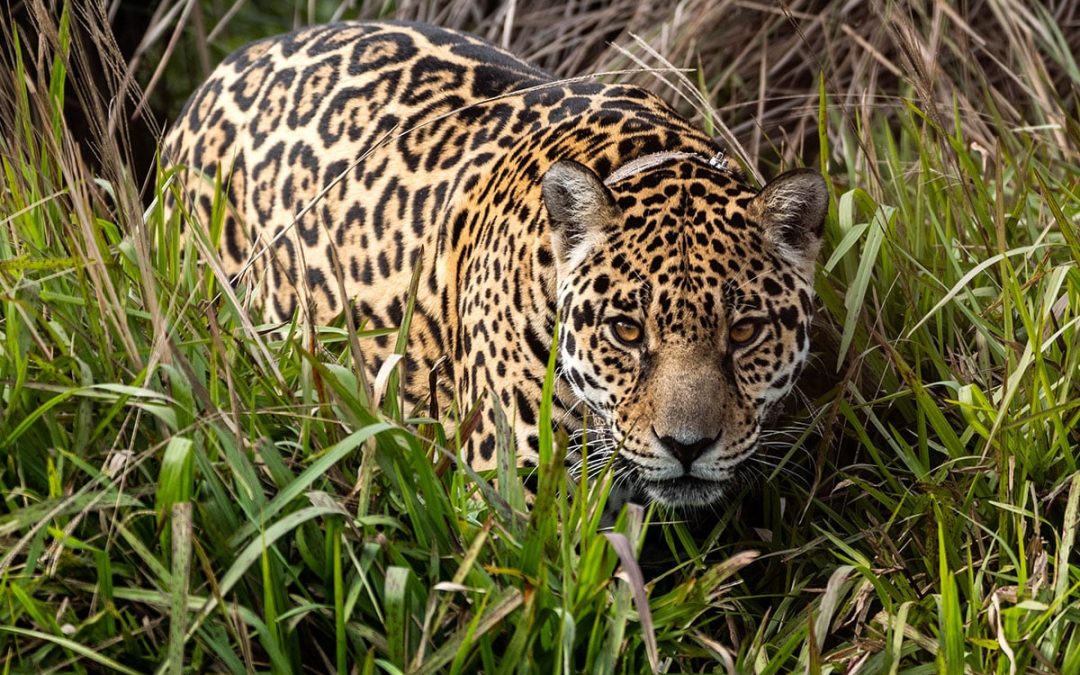
Photo credit: Sebastián Navajas / Rewilding Argentina
Are there Jaguars in Argentina?
Jaguars are still present in Argentina but their population are highly reduced and fragmented; rewilding is helping restore their role in key landscapes such as Iberá and El Impenetrable. Learn how Rewilding Argentina is helping return these majestic species and rewilding entire landscapes.
While the rewilding movement is operating on a truly global scale, it is good to remind ourselves that the interconnected whole is one that comprises individuals. Rewilding, after all, is built on the reinvigoration of individual ecosystems. The saving of individual species. And, in Argentina, for instance, the reintroduction of individual jaguars (Panthera onca).
In March 2024, a female jaguar named Keraná was released into El Impenetrable National Park, in the far north of Argentina. This was a significant event in itself and also an important step in the re-establishment within the area of healthy wild populations of this apex predator – the largest feline in the Americas.
Why Jaguars matter to ecosystems
“Jaguars are one of the top predators [in Argentina], they control the populations they feed on,” said Alejandro Serrano, a biologist at the Corrientes center. “They make the environment balanced. When we hunted them, we took away one of the most important pieces of the puzzle — it is unnatural, unbalanced. There are more herbivores than there should be.” Reintroducing Jaguars reintroduces balance. “When we put them back, we see that they have had a key role in [rejuvenating] endangered bird populations,” he added. “With Jaguars again, we see less Foxes, and Foxes used to prey on the Bird eggs.” The region’s grasslands, previously ravaged by a rampant population of Capybaras, have recovered too.

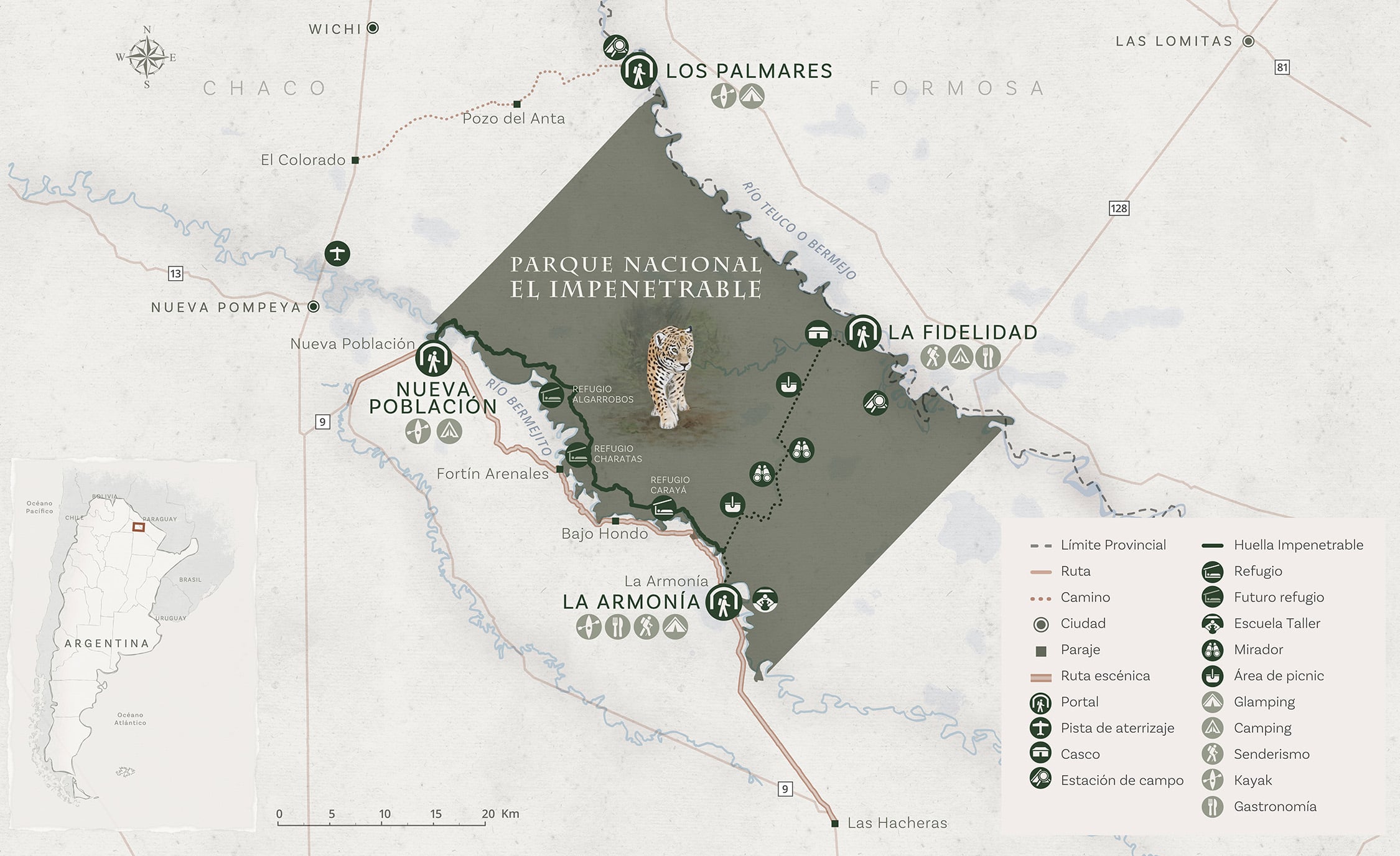
Photo credit: Sebastián Navajas / Rewilding Argentina
Map credit: Map of El Impenetrable, Argentina / Leticia Kutianski – Rewilding Argentina
Rewilding El Impenetrable National Park
El Impenetrable National Park is a protected area set within the Gran Chaco ecoregion, a semi-arid forest that spans parts of Argentina, Brazil, Paraguay, and Bolivia. The region – although not as renowned internationally as the Amazon rainforest – is one that is hugely important for biodiversity. But its once-thriving jaguar population currently numbers fewer than 20 individuals; and no females have been recorded there in two decades. A crucial element in restoring wild reproduction for jaguars in the Gran Chaco, therefore, is the reintroduction of potential mothers. And Keraná is the first.
Keraná was rescued in Paraguay, when she was found as a cub after her mother had been killed by hunters. Her release into El Impenetrable National Park was led by Rewilding Argentina (an offshoot of Tompkins Conservation), working in collaboration with the National Parks Administration of Argentina. She is soon to be followed by a second female, named Nalá, who is the first jaguar born in semi-captivity in the national park.
Sebastián Di Martino, who is Conservation Director of Rewilding Argentina, notes: “Wild jaguars need genetic diversity and connectivity to thrive. Bringing back female jaguars is a momentous step. We are optimistic that their arrival to the Chaco Province will transform a population from near extinction to a healthy reproductive one.”
This jaguar reintroduction work is being conducted alongside projects to reintroduce or bolster several other species in El Impenetrable National Park, including:
- the giant otter (Pteronura brasiliensis), an apex predator of the water;
- the marsh deer (Blastocerus dichotomus), South America’s largest cervid and a key herbivore in wet grassland;
- the red-footed tortoise (Chelonoidis carbonarius), a fruit-feeder and important seed disperser;
- and the lowland tapir (Tapirus terrestris), another important disperser of seeds.
The work is also being carried out within a wider context of jaguar reintroductions elsewhere in Argentina, including within the majestic Iberá Park in the north-eastern corner of the country.

Photo credit: Rewilding Argentina
Rewilding Iberá Park
Iberá Park is a matrix of wetland, grassland, and forest that exceeds 750,000 hectares in extent. Here, Rewilding Argentina has been working since 2012 – in collaboration with the provincial government and the National Parks Administration of Argentina – to re-establish the presence of the jaguar as part of a broader initiative to increase the health and vibrancy of what is an extraordinary place for wildlife.
Human activities, such as hunting and cattle ranching, led to the extirpation of the jaguar in the Iberá region more than 70 years ago. With the recent reintroductions, however, there are now at least 20 of these iconic felines roaming Iberá Park. And as a sign of the growing health of this population, two wild-born cubs were observed on a camera trap in 2022. This event – the first-known wild birth of jaguars in the area since the species’ extirpation – is not just a moment of major symbolic importance, but also a pivotal biological development in the jaguar’s return to self-sustaining vitality.
The parents of the wild-born cubs, Jatobazinho and Arami, were released in Iberá Park in 2021. Jatobazinho, the father, is a rehabilitated wild jaguar from Brazil, while Arami (pictured above, behind her sibling Mbarete) is the first jaguar to have been born at a specially built reintroduction centre in Iberá Park (see photograph below).
These positive developments could not have come soon enough. In Argentina, the distribution of jaguars has declined to less than five per cent of its former extent, and the estimated population of 200–250 wild animals is severely fragmented. But repairing such ruptures is all part of rewilding’s mission. Indeed, Di Martino sees great potential in creating jaguar corridors, which would also benefit other species and aid in landscape-scale ecological restoration.
This vision is a compelling one. And it is being realised through individual interconnected steps.

Photo credit: Rewilding Argentina
Wider impact
Rewilding Argentina, offspring of Tompkins Conservation, was created in 2010 to build on ongoing work to restore fully functioning ecosystems and promote the well-being of local communities. Through this work, which has been carried out in collaboration with the national and provincial governments, nine national parks have been created or expanded in Argentina, spanning 1 million hectares of land and sea. Keystone species have been successfully reintroduced, bringing balance to the ecosystems from which they were missing.
Local communities are at the heart of Rewilding Argentina’s projects, not least through their focus on ecotourism and the creation of regenerative economies, and the suite of initiatives is helping to reconnect people with the vast landscapes of Argentina.
Rewilding is a credible and cost-effective solution for our times.
Find out why Nature is our best ally.


