
Photo credit: Kaziranga National Park Assam – Indian One Horned Rhinoceros, Sumon Das
Wild animals are the original and best carbon-capture ‘technology’
Through grazing, trampling, and even their waste, wildlife shapes ecosystems in ways that boost their capacity to absorb and store carbon.
Bringing back key animals to their habitats could help capture billions of extra tonnes of CO2 every year.
Animating the Carbon Cycle (ACC) is an emerging field of science and policy that’s gathering rigorous, peer-reviewed evidence and building a model to measure exactly how much animals help the climate.
This is building a strong case for rewilding, showing that nature recovery is a credible, scalable and cost-efficient climate solution.
Animating the Carbon Cycle Case Studies
Developed by Yale School of the Environment and the Global Rewilding Alliance, the Yale/GRA ACC Model is a practical tool for quantifying the climate benefits of restoring and protecting wildlife populations. By measuring the legacy carbon being stored and captured, the model helps guide rewilding efforts and investment worldwide, turning ecosystems into powerful solutions for both the climate and biodiversity crises.
The model’s case studies show that key species can more than double an area’s carbon capture.
Bahrain
Dugongs could help Bahrain’s seagrass capture 2.4x more carbon
Peer-reviewed study
Chile
Pumas & Guanacos could capture more than 2x carbon in Chile’s grasslands
Study currently under peer review
Mexico
Pumas, Jaguars, Deer, Peccaries could 3x carbon capture in Mexico’s forests
Study pending peer review
We are currently reviewing the impact of European Bison in Romania, Forest Elephants in Congo, Savannah Elephants in Zimbabwe, Saiga Antelopes in Kazakhstan, Rats in island ecosystems, Bison in Canada, Puma & Capybara in Argentina.
If you have a candidate species or ecosystem that you would like to assess using the model please get in touch.
Animating the Carbon Cycle Research

Trophic Rewilding Can Expand Natural Climate Solutions
Published on March 27, 2023, in Nature Climate Change, this pivotal study reveals that rewilding 9 key wildlife species could help remove 6.4 billion tonnes of CO2 from the atmosphere every year. That’s as much as some of the biggest climate strategies the world’s top scientists (the IPCC) have identified, making rewilding a serious, large-scale climate solution.
Cutting emissions isn’t enough on its own, we also need to pull out the extra CO2 that’s already built up in the atmosphere since the industrial era. The best place to store excess CO2 is in soils and sediments of the land and ocean. But until recently, we’d been undervaluing the role animals play in controlling the carbon cycle. Rooted in rigorous scientific evidence, this study reveals that wild animals could increase an ecosystem’s carbon budget by 60–95%.
WILD ANIMALS ARE CLIMATE HEROES
These 9 species have been studied in specific environments to understand how they shape their ecosystems and how much carbon they help store, revealing astonishing results. These ‘Climate Heroes’ can draw down
6.4 Billion Tonnes of CO2 annually.
.
Wildebeest in the Serengeti can capture 4.4 Megatons of CO2/y
Sea Otters in British Columbia can capture 5.2 Megatons of CO2/y
Grey Wolf in British Columbia can capture 260 Megatons of CO2/y
Musk Oxen in the Arctic can capture 30 Megatons of CO2/y
Marine Fish in the Mesopelagic Zone can capture 5.5 Gigatons of CO2/y
Sharks across the World’s Coral Reefs can capture 108 Megatons of CO2/y
African Forest Elephants in the Congo can capture 13 Megatons of CO2/y
American Bison in Prairie Grasslands can capture 595 Megatons of CO2/y
Baleen Whales in the Southern Ocean can capture 0.62 Megatons of CO2/y
.
.
Climate Hero image credits: Unsplash & Pexels, plus African forest elephant – Robin James Backhouse, Duskyshoulder trevallies – Milos Prelevic, Tiger shark – Gerald Schömbs, Musk oxen – Neil Burton
Insights & Updates
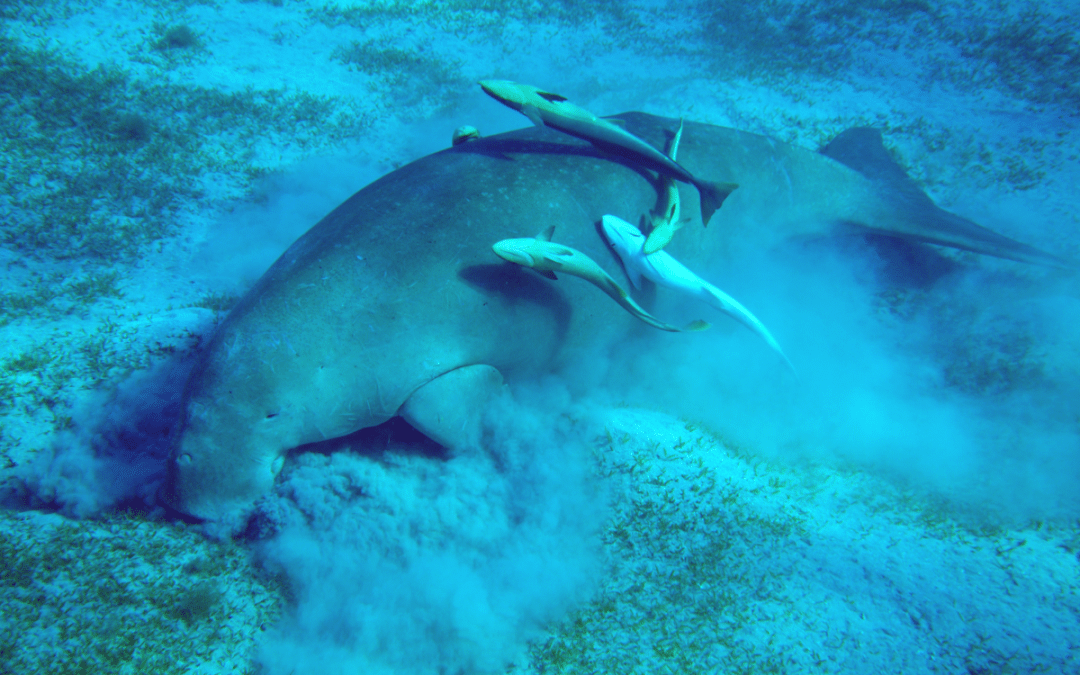
Dugongs, the climate heroes that more than double the carbon capture & storage of Bahrain’s seagrass meadows
A new study estimates that Bahrain’s seagrass ecosystems could capture approximately 546,000 tonnes of CO₂ annually when healthy Dugong populations are present. The findings add evidence that wild animals play a far bigger role in carbon capture than we account for in current climate policy frameworks globally.

Tigers and Climate: First-of-its-kind research in Asia finds a dual win for nature and climate policy
New research published in Global Change Biology (Roberts et al., 2025) reveals that forests with healthy populations of wild Tigers store more carbon than ‘empty forests’ without Tigers — advancing the goals of both the Convention on Biological Diversity (CBD) and the UN Framework Convention on Climate Change (UNFCCC). This provides additional compelling evidence that wildlife recovery is a critical, yet often overlooked, tool in climate mitigation.
Photo credit: Girishacf from Getty Images
lead author of the report and developer of the model

Working with nature to supercharge climate mitigation
If you have a candidate species or ecosystem that you would like to assess using the Yale/GRA ACC model, get in touch by sending us an email:
Learn more about Animating the Carbon Cycle


