
Virelles landscape view. Photo credit: O. Colinet.
In the Parc National de l’Entre-Sambre-et-Meuse, Belgium, forests are being left to evolve freely again, rivers are reclaiming their natural courses, and species long absent are finding their way back. Covering more than 22,500 hectares across five communes – Viroinval, Couvin, Chimay, Froidchapelle, and Momignies – the ESEM NP spans three distinct natural regions. They allow large forest areas to evolve in their own accord, free from human forestry management whilst being monitored methodically. Along the Eau Blanche river, 20 meanders have been restored, with a huge boost in biodiversity expected. As it covers different regions and communes, the ESEM NP takes on a participatory governance and citizen involvement approach. The aim is fully restored landscapes by 2041.
A few members of our team can say that they are familiar with the landscapes of Belgium… or so, that’s what they thought!
It can be easy for one to reserve the title of ‘wild’ for landscapes on different and far away continents; the places we learn about, hear about or dream of visiting with weird and wonderful animals and scenes that stretch into the horizon. We can all too easily omit the extraordinary native wildlife that belongs near to us from memory. We challenge you: imagine what happens when we seek the wild within our own country.

White-throated Dipper. Photo credits: L. Malbrecq
In the southern landscapes of Wallonia, the Parc National de l’Entre-Sambre-et-Meuse (ESEM) is opening the door for this wild imagination in Belgium. Here, forests are being left to evolve freely again, rivers are reclaiming their natural courses, and species long absent are finding their way back, benefiting people along the way with more than wonder and awe (that are both in plenty too!).

The observation tower: Tour de la Calestienne. Photo credit: ESEM National Park.
The ESEM NP is one of Belgium’s first national parks and through renature, reconnect and rethink – the three pillars of their work – this landscape is being reborn into something both ancient and new.
A Territory of Wild Richness
Covering more than 22,500 hectares across five communes – Viroinval, Couvin, Chimay, Froidchapelle, and Momignies – the ESEM NP spans three distinct natural regions, each bringing its own geological, botanical, and wildlife treasures. The Ardenne has ancient forests home to red and roe Deer, Black Stork, Wild Cat and more. The Calestienne features vibrant calcareous grasslands teeming with Orchids and butterflies. The Fagne hosts rivers, wetlands and meadows of rare quality.

Ophrys bourdon. Photo credit: Wim Melis.
This diversity of habitat supports around 80% of Wallonia’s species, and features 26 habitats of Community interest (HCI) under European biodiversity directives.
Letting Nature Lead: Rewilding & Free evolving Forests
One of the ESEM NP’s biggest initiatives is to allow large forest areas to evolve in their own accord, free from human forestry management. Nearly 1,900 hectares of public forests are set to become Integral Forest Reserves: biological reserves where nature’s own processes, such as natural regeneration, aging trees, deadwood, and natural disturbances, are allowed to shape the forest.

‘Libre evolution’ (i.e. unmanaged) forest. Photo credit: ESEM National Park.
To understand how these forests change over time, the ESEM National Park has commissioned a monitoring methodology. Partners include the University of Liège, INRAE, Ecofirst, and researchers from several other institutions are involved in mapping, monitoring ecological indicators, and baseline surveys to track forest structure, species, connectivity and ecosystem resilience.
Scientific monitoring is only part of the picture. The ESEM National Park also looks beyond Europe for perspective, inviting voices like Mundiya Kepanga, a Huli tribal chief from Papua New Guinea, to help rethink humanity’s relationship with nature and what it truly means to act for the forest. By bringing indigenous knowledge into dialogue with ecological science, the initiative aims to generate insights that are as much about values and worldview as they are about data.
The knowledge and discoveries that flow from this kind of long-term curiosity hopes to inspire initiatives across Europe and cross-continentally.
Reviving Landscapes: grasslands to rivers
Beyond forests, the ESEM NP is preserving and restoring several other key landscape elements, notably:
Calcareous grasslands (pelouses calcaires) are being restored by removing conifer plantations reintroducing nomadic grazing – reviving a lost local tradition – so that these biodiverse habitats can flourish again.

Roche a Lomme viewpoint. Photo credit: F. De Schutter.

Agropastoralism. Photo credit: ESEM National Park.
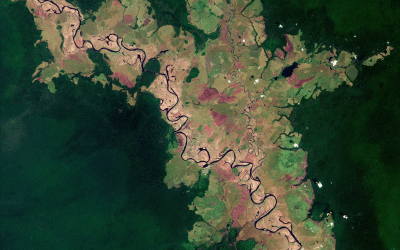
Rivers and streams like the Eau Blanche, along with their floodplains and wetlands, are part of rewilding efforts to improve water quality, habitat connectivity, and flood resilience. The Eau Blanche river was severely altered in the 1960s, straightened, deepened, and the valley was drained in pursuit of agricultural productivity that never materialised. Today, that damage is being undone. In what is now the largest remeandering project in Wallonia, 20 meanders have been restored, returning a 2,6km portion of the Eau Blanche to its original course. A huge boost in biodiversity is expected, as the ecosystem recovers.

Eau Blanche remeandering. Photo credit: ESEM National Park.
Through these initiatives, nature is allowed to recover and take care of herself.
People, Governance & Nature Together
As it covers different regions and communes, the ESEM NP takes on a special approach:
- Participatory governance: The project is managed through a Partner Coalition of 26 partners, constituting the general assembly of the National park NGO including the five municipalities, environmental NGOs, tourism and cultural bodies. There is also a broader Coalition of around 80 members supporting the project.
- Citizen involvement: Surveys, public consultations, and community events all play a key role. Perspectives of local inhabitants, visitors, and users are being actively included in shaping restoration, ecotourism, and nature experiences.
A 2041 Vision
By 2041, the ESEM NP imagines restored landscapes: resilient forests, interconnected Calestienne ecological networks, free-flowing waterways, and thriving ecosystems offering benefits to both nature and people.
Check out their 10 goals by 2041.
The Entre-Sambre-et-Meuse National park is a hopeful, inspiring story in progress. Recently, they have become part of the Wilder Parks initiative of Rewilding Europe. As part of the 10 national parks across Europe leading a different way of stewarding national parks, they show us what can be done when people are reminded that they live in a place that holds wild, natural beauty, and that they’re part of it.

Topoguide: ESEM National Park.
And if you’re heading to Belgium, have a look at their interactive map!
We are proud to have them in our Alliance!

About the Global Rewilding Alliance
The Global Rewilding Alliance brings together over 300 organisations across every continent to catalyse a worldwide movement for nature’s recovery. We accelerate learning, convene evidence, and share the successes and benefits of rewilding —inspiring more organisations to rewild and unlocking new resources for rewilding. Learn more about our work.