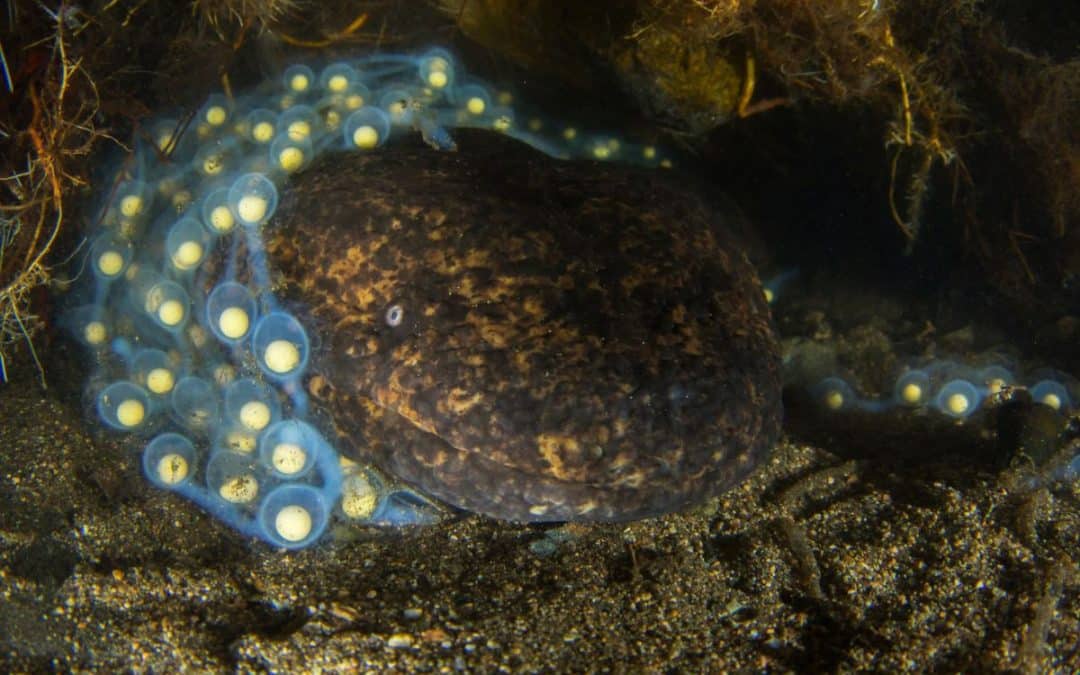
Japanese giant Salamander guarding eggs in its den. Capturing the image took years of preparation and planning. Photograph: Yukihiro Fukuda_TopOutImages
Sustainable Daisen, the first Japanese partner in the Global Rewilding Alliance, is a non-profit dedicated to protecting the endangered Japanese Giant Salamander and restoring freshwater and rural landscapes on Mount Daisen, Tottori Prefecture. Founded by Richard Pearce in 2021, the organisation bridges international rewilding principles with traditional Japanese land stewardship. Its initiatives include restoring river connectivity with bypass ramps, promoting organic farming on abandoned land, and engaging local communities and schools in environmental education. By revitalizing both ecosystems and rural communities, Sustainable Daisen is creating a practical blueprint for nature recovery across Japan.
On the slopes of Mount Daisen in Tottori Prefecture, a small non-profit is leading one of Japan’s most innovative rewilding initiatives, centred around an animal many people have never heard of: the Japanese Giant Salamander.
Sustainable Daisen’s mission is to protect this ancient amphibian and restore the rivers, forests and rural landscapes on which it depends. In doing so, the organisation is also helping to revitalise local communities and demonstrate how nature recovery can benefit both wildlife and people.
We are particularly excited to welcome Sustainable Daisen as the first Japanese partner in the Global Rewilding Alliance network. Bridging international rewilding principles with traditional Japanese approaches to land stewardship, the organisation is developing a model for freshwater and rural rewilding that could inspire similar efforts across the country.
Having started as a small local initiative, Sustainable Daisen works at the intersection of ecological restoration, community engagement and sustainable agriculture. Its ambition is not only to recover nature around Mount Daisen, but also to create a practical blueprint for nature recovery in rural Japan.

Sustainable Daisen is dedicated to protecting the endangered Japanese Giant Salamander and restoring freshwater and rural landscapes on Mount Daisen, Tottori Prefecture. Credit: Sustainable Daisen
A Living Fossil: The Japanese Giant Salamander
The Japanese Giant Salamander is one of the world’s largest amphibians and has remained virtually unchanged for around 23 million years. Officially designated a Special Natural Monument, it receives the highest level of protection afforded to Japan’s natural heritage—equivalent in status to the protection given to the country’s most treasured cultural assets.
As an apex predator, the species plays a vital role in maintaining balanced and biodiverse freshwater ecosystems. It is also an important indicator of river health, surviving only in fast-flowing, cold, well-oxygenated mountain streams with clean water and intact habitats. Rivers capable of supporting healthy breeding populations of Giant Salamanders are also healthy rivers for countless other species and for the people who depend on them for drinking water, agriculture and other essential resources.
Yet despite this prestigious status, the species faces an uncertain future. River engineering, migration barriers, habitat degradation, pollution, invasive species and hybridisation continue to threaten wild populations. While the Japanese Giant Salamander is legally protected, relatively few organisations are carrying out practical, on-the-ground conservation to reverse its decline.

Measuring a giant Japanese Salamander. Credit: Sustainable Daisen
A Wider Socio-economic Challenge
The threats facing the Japanese Giant Salamander reflect broader challenges affecting rural Japan.
As the country’s population ages and younger generations move to urban centres, many villages are shrinking. Agricultural land is abandoned, forests become neglected, and fewer people remain to manage rivers, irrigation systems and traditional landscapes. These changes can have significant consequences for biodiversity, while also making rural communities increasingly vulnerable to environmentally damaging development.
This is where rewilding can play an important role—not simply by restoring nature, but by reconnecting people with the landscapes on which they depend.
Among those leading this work is Richard Pearce, who founded Sustainable Daisen in 2021 after living in Japan for more than 15 years. Speaking to The Guardian, he reflected on the urgency of protecting the species:
Twenty-three million years of DNA might die out on our watch. I honestly believe that if I don’t do anything in time, no one else will.
Richard Pearce, Sustainable Daisen Founder

Richard Pearce founded Sustainable Daisen in 2021 after living in Japan for more than 15 years. Credit: Sustainable Daisen
Rewilding Rivers for Salamanders, Farmers and Communities
Guided wildlife tours have become one of Sustainable Daisen’s most effective conservation tools. By introducing visitors to the Japanese Giant Salamander and its remarkable habitat, the organisation generates support for conservation while building strong relationships with local communities.
Working alongside residents, volunteers, universities and local authorities, Sustainable Daisen restores river habitats, removes invasive vegetation and improves river connectivity. One flagship initiative involves installing bypass ramps on weirs, allowing Giant Salamanders to move more freely through the Nawa River system.
The organisation also works with local communities to address wider environmental issues. By supporting village initiatives and helping to prevent developments that could threaten freshwater ecosystems, Sustainable Daisen demonstrates that protecting the Salamander also means protecting the health and resilience of local communities.
The forest and river system that supports the Japanese Giant Salamander is the same system that provides clean water for downstream villages and agriculture. Protecting the salamander’s habitat ultimately protects the natural resources upon which people depend.

The Japanese Giant Salamander is one of the world’s largest amphibians and has remained virtually unchanged for around 23 million years. Credit: Sustainable Daisen
Organic Farming for Healthy Rivers
Recognising that restoring healthy rivers requires action beyond the water itself, Sustainable Daisen also works to restore abandoned farmland and promote environmentally responsible agriculture.
The organisation leases neglected land, supports organic farming and encourages rewilding where appropriate, helping reduce pollution while creating healthier conditions for wildlife.
Through its composting programme, discarded temple flower offerings are transformed into free organic fertiliser, which is used to grow produce and support local farmers. The wider Daisen Organic initiative exists to strengthen small-scale organic farming in the region, helping create economically viable alternatives to chemical-intensive agriculture while improving freshwater ecosystems.

One of two artificial Shelter designs for the Japanese Giant Salamanders, to be deployed in degraded rivers, thereby increasing the availability of shelter and nesting sites for the iconic species. Credit: Sustainable Daisen
Building Support for the Salamander
Long-term conservation depends on people as much as wildlife.
Through artwork sales, one supporter raised enough money to provide 36 nature books—one for every local elementary school—which were presented to the local Board of Education. As a result, children throughout the area are learning about the remarkable animal living in their own rivers.
Community rewilding projects have also brought together local residents, university students and volunteers, including members of the US military stationed in Japan, to help install salamander bypass ramps and restore habitats.
As Alister Scott, Executive Director of the Global Rewilding Alliance, often says:
Big change happens when human hearts are moved.
Rewilding Benefits: Nature, Communities and the Future
Like many successful rewilding initiatives, Sustainable Daisen’s work extends far beyond wildlife conservation.
Its projects contribute to healthier rivers, restored habitats, sustainable agriculture, environmental education, nature-based tourism and stronger community engagement. Together, these initiatives demonstrate that ecological restoration can also deliver meaningful social and economic benefits.
Although still a young organisation operating with a small team and a modest budget, Sustainable Daisen continues to grow. It has recently established a permanent headquarters in a traditional Japanese home beside the Nawa River, is stewarding an increasing area of land, and is seeing growing international interest in its rewilding, conservation and ecotourism programmes.
As the first Japanese partner of the Global Rewilding Alliance, Sustainable Daisen represents an exciting step in bringing rewilding principles to one of the world’s most culturally and ecologically distinctive landscapes. By combining ecological restoration, species conservation and community-led action, the organisation is helping develop a uniquely Japanese approach to nature recovery—one that could inspire similar efforts across the country.
Visit Sustainable Daisen’s website and follow them on social media to learn more about their work and discover how you can support rewilding in Japan.

A Japanese Giant Salamander. Photograph: Yukihiro Fukuda_TopOutImages