
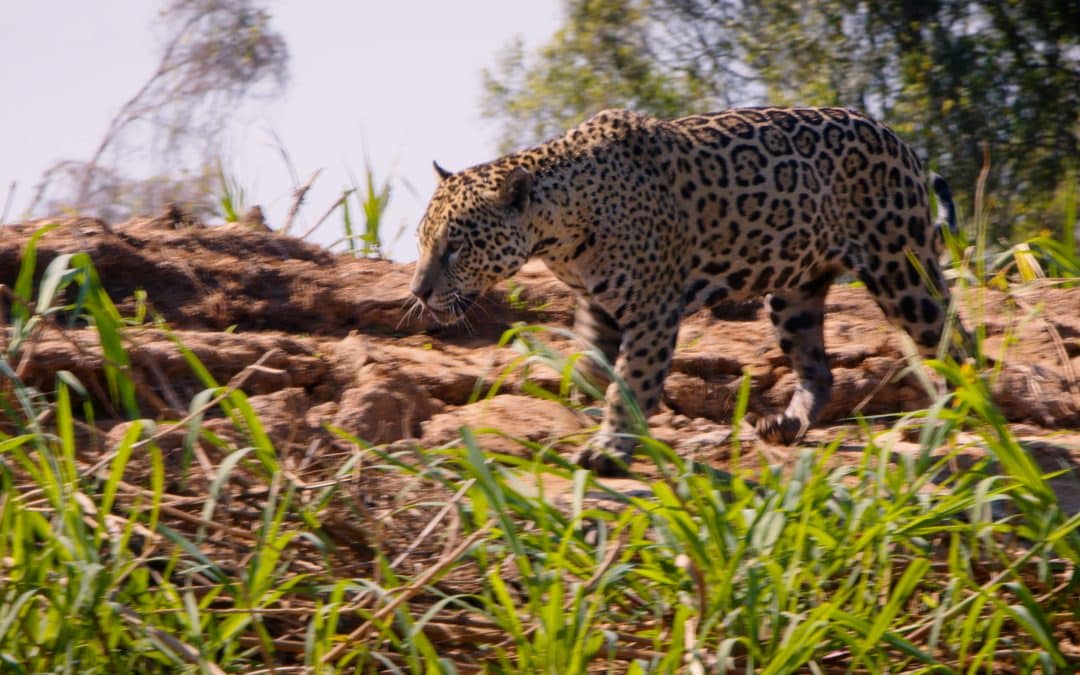
Credits: Instituto Pró-Onça
Pró-Onça Instituto, in the vast Cerrado Savanna, on the edge of the Atlantic Forest, protects and rewilds Jaguars, the web of life they influence and ecosystem-wide processes they drive. Through four partnerships around Pireneus State Park and Brasília National Park, they are creating corridors for wildlife. Pró-Onça team combines science with indigenous knowledge, planting native seedlings chosen by scientists and indigenous members alike, incorporating local ecological knowledge into the restoration design. Their team is filled with women: scientists, field biologists, rangers, and community educators, all working together to create the conditions where humans and apex predators can thrive.
Writing about the work of our Alliance Partners brings us to many corners of the world, places we’ve not necessarily been able to see first hand. It’s a magical thing that storytelling can make us feel close to such places.
Pró-Onça Instituto has made our team travel all the way to the southern landscapes of Brazil. In the vast Cerrado Savanna, on the edge of the Atlantic Forest, let us take you along Pró-Onça’s journey – one led by a woman and her deep love for Jaguars.

Letícia Benavalli, Director of Pró-Onça. Credit: Pró-Onça Instituto.
The Call of the Jaguar
Across many Indigenous cultures in the Americas, the Jaguar is seen as a guardian spirit of the forest, woven into stories about protection, balance, and the invisible connections that keep forests, rivers, wildlife and people alive.
When big Cats disappear, the forest falls silent. And where they return, life comes back in abundance; the Deer, Capybara, Macaws, and rivers find their place again.

The first non-melanistic female Jaguar recorded in this landscape after years of presumed local disappearance. Credit: Pró-Onça Instituto.
That’s why Pró-Onça was born: to protect these apex predators and the entire web of life they influence and ecosystem-wide processes they drive. Their mission reaches beyond the animal itself and towards coexistence between humans and nature, creating the conditions where both can thrive.
Women Leading the Way
In a field still dominated by men, Pró-Onça decided early on to change not only what conservation looks like, but who leads it. Their team is filled with women: scientists, field biologists, rangers, and community educators. Each bringing new voices and perspectives into the landscapes they protect.

The first group of women trained through the “Jaguar Women for Climate and Conservation” initiative. Credit: Pró-Onça Instituto.
You’ll find them trekking through dense rainforest, setting up camera traps, analysing Jaguar footprints, interviewing local farmers, and leading environmental education sessions for children.
For this team, science is about storytelling and building relationships as much as it is about data. In landscapes where fear, conflict and disconnection have grown over time, rebuilding relationships between people and nature becomes a form of restoration itself. For the Pró-Onça team, rewilding is about protecting species, but also about restoring coexistence and the sense of belonging between communities and the landscapes they call home. They recognise that long-term conservation is deeply connected to social well-being, creating meaningful opportunities for the people who live alongside wildlife.

Pró-Onça Instituto staff, Ademar and Leticia. Credit: Pró-Onça Instituto
Science and People
Pró-Onça’s approach is rigorous and rooted in empathy. Through ecological research and community participation, Pró-Onca is showing that protecting big cats goes hand in hand with supporting people.
By working closely with local women, ranchers, and Indigenous leaders, they help reduce conflict, encourage sustainable livelihoods, and restore mutual respect for wildlife.
An example that was shared with us from their team demonstrates the importance of learning from the community:
During one regeneration effort, the team initially planned to use a more conventional seedling-based restoration approach, focused on native tree species commonly used in Cerrado recovery projects. Community members, however, suggested prioritising species they had long observed thriving naturally in the region’s dry soils and harsh climate conditions, including pequi (Caryocar brasiliense), jatobá-do-cerrado (Hymenaea stigonocarpa), ipê-amarelo (Handroanthus ochraceus), murici (Byrsonima crassifolia), baru (Dipteryx alata), cagaita (Eugenia dysenterica), and lobeira (Solanum lycocarpum).
The Pró-Onça team decided to combine both approaches, planting native seedlings while incorporating local ecological knowledge into the restoration design. Over time, the areas shaped by community knowledge showed faster vegetation recovery and stronger wildlife return.

Pró-Onça team members alongside rural landowners neighbouring Pireneus State Park, in the Brazilian Cerrado. Credit: Pró-Onca Instituto
Connecting Core Areas
In 2003, Letícia Benavalli, Director of Pró-Onça, mapped all the paths of the Jaguars and identified the priority areas for breeding. A lot of these areas fell into private lands and parks which required building relationships over time. Encouragingly, they were all keen to collaborate.
Pró-Onça now has four partnerships around Pireneus State Park and Brasília National Park in some spectacular landscapes; the Cerrado region and the Atlantic Forest. The Cerrado region, for example, is the second largest biome in South America and the most biodiverse savanna in the world. Most of its biomass is located underground in the form of deep root systems that channel rain into soil reservoirs, in turn feeding the Amazon and two other water basins in the southern regions of South America.
Creating corridors to reconnect these areas together, will undoubtedly have cascading effects for local populations.

Melanistic Jaguar, later recorded with a cub, proof that life is still persisting and reproducing within these fragmented forests. Credit: Pró-Onça Instituto.
And so, the story of Pró-Onça isn’t just about saving Jaguars and big cats. It’s reviving whole and healthy ecosystem processes, creating an enticing place for species to come back. You can meet the extraordinary species on Pró-Onça’s Wildlife Watchlist, from Anteaters, Armadillos, Crab eating Foxes and many more – this will give you an idea of the intricate web that connects us all.
A Future Led by Women, Guided by the Wild
As Pró-Onça looks ahead, the vision is clear: more corridors for big cats to roam safely, more forests alive with sound, and more women leading the charge for science, rewilding, and equality.
Pró-Onça reminds us that when we protect our wild kin, we protect ourselves.