
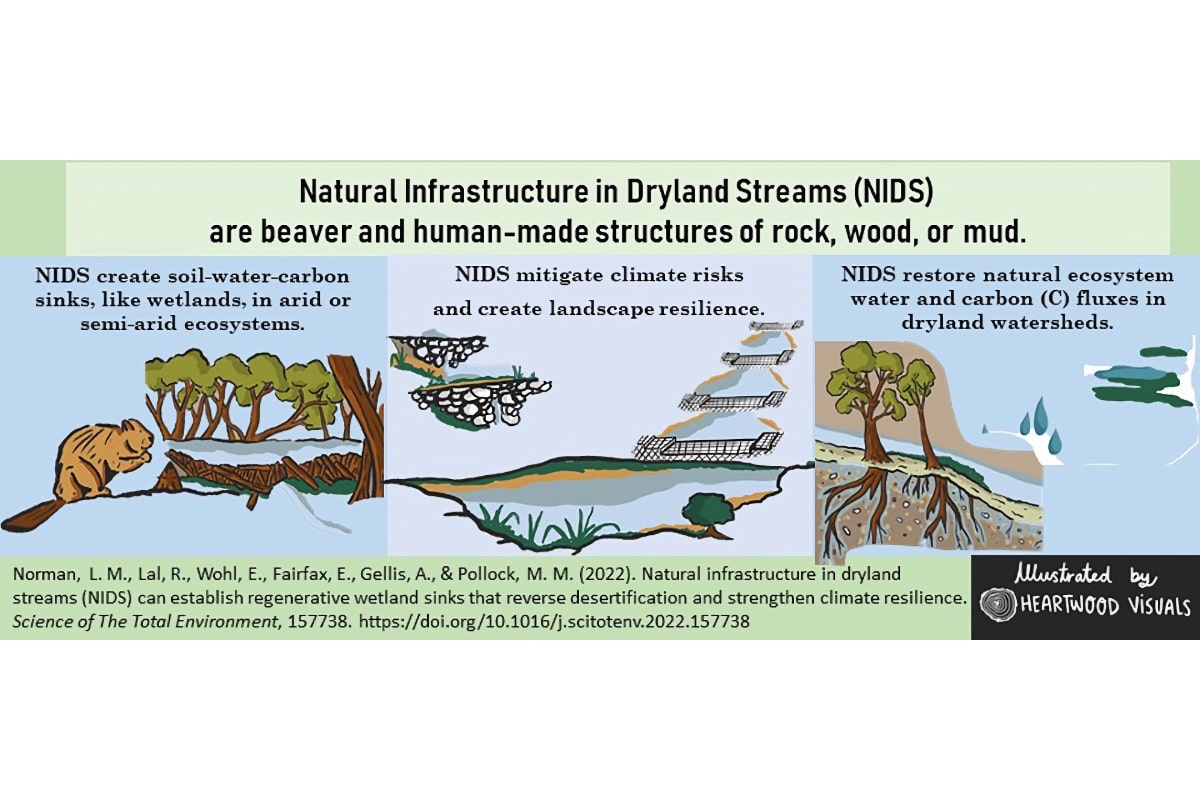
The authors introduce Natural Infrastructure in Dryland Streams (NIDS), which are structures naturally or anthropogenically created from earth, wood, debris, or rock that can restore implicit function of these systems. In addition, we present the novel, evidence-based finding that NIDS can create wetlands in water-scarce riparian zones, with soil organic carbon stock as much as 200 to 1400 Mg C/ha in the top meter of soil. The authors also identify the key restorative action of NIDS, which is to slow the drainage of water from the landscape such that more of it can infiltrate and be used to facilitate natural physical, chemical, and biological processes in fluvial environments. Specifically, we assert that the rapid drainage of water from such environments can be reversed through the restoration of natural infrastructure that once existed. They then explore how NIDS can be used to restore the natural biogeochemical feedback loops in these systems. We provide examples of how NIDS have been used to restore such feedback loops, the lessons learned from installation of NIDS in the dryland streams of the southwestern United States, how such efforts might be scaled up, and what the implications are for mitigating climate change effects.

Policy & Community Wins for Nature: $200M for 100 species, a New UNESCO Site & More
2026 is delivering major wins for nature recovery and rewilding. Credit from left to right: 1. Filmico, Acandi Wildlife Sanctuary 2. Marcus Westburg, Rainforest Trust 3. Zanji Sikhala, IFAW 4. Tsvibrav from Getty Images 5. Kamchatka 6. John Carnemolla from Getty...