
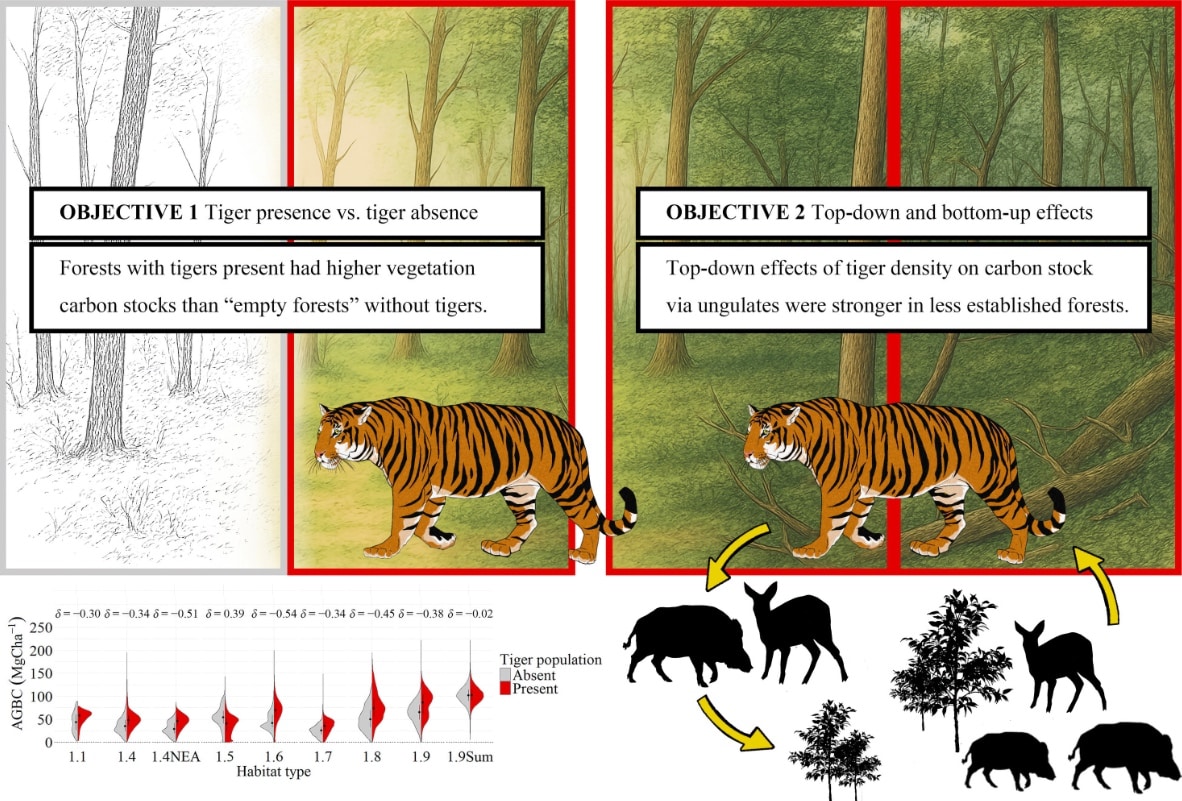
Globally, forests with tigers living within them store more vegetation carbon than forests without tigers, near consistently across forest habitat types. Our results also showed that in disturbed forests, tigers appear to exert top-down control of carbon stocks through impacts on ungulate biomass where ungulate biomass and carbon stocks are low; in contrast, in more established forests with higher ungulate biomass and carbon stocks, tiger-carbon relationships are more likely bottom-up at the scale of our analyses. Additionally, tiger density is positively related to carbon stock in vegetation or soil in four forest habitat types or reached tiger-carbon peaks.

Policy & Community Wins for Nature: $200M for 100 species, a New UNESCO Site & More
2026 is delivering major wins for nature recovery and rewilding. Credit from left to right: 1. Filmico, Acandi Wildlife Sanctuary 2. Marcus Westburg, Rainforest Trust 3. Zanji Sikhala, IFAW 4. Tsvibrav from Getty Images 5. Kamchatka 6. John Carnemolla from Getty...