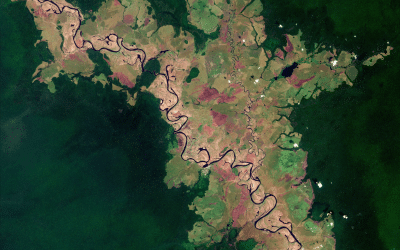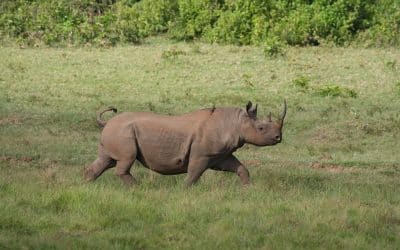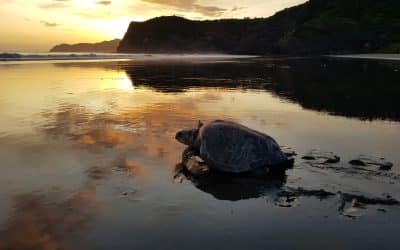
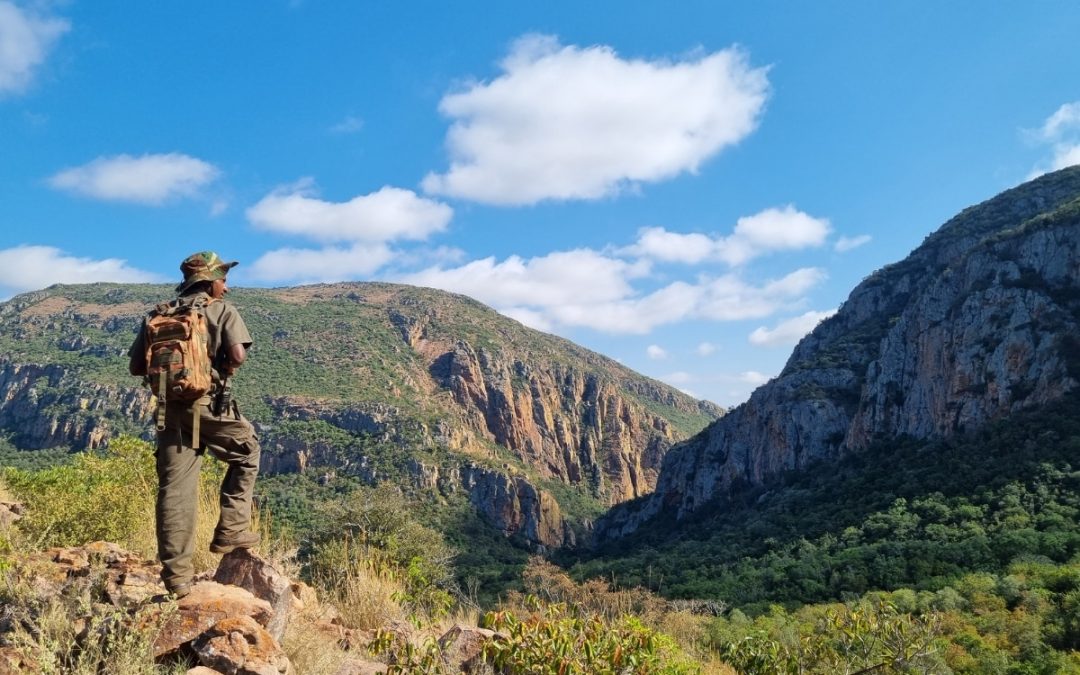
Looking out across large-scale wildlife corridor in Africa. Credit: Endangered Wildlife Trust.
Endangered Wildlife Trust, a longstanding Alliance Partner located in South Africa, operating throughout Southern and Eastern Africa, have been paving the way for large-scale and connected rewilding; we want to take a moment to spotlight the work of this inspiring and longstanding partner of the Global Rewilding Alliance. Working across 9 priority Strategic Conservation Landscapes, the Endangered Wildlife Trust’s mission is to restore and protect these landscapes to empower communities, secure-expand-connect protected areas for threatened species and build ecological resilience for people and wildlife. We explore their Future Fit Strategy 2025-2050 that is based on three programmatic actions: stabilise threatened species, restore and protect vast landscapes and empower people.
A vision of resilience for communities and wildlife
Working across 9 priority Strategic Conservation Landscapes throughout Southern and Eastern Africa, the Endangered Wildlife Trust’s mission is to restore and protect these landscapes to empower communities, secure-expand-connect protected areas for threatened species and build ecological resilience for people and wildlife.
The Trust achieves impact at scale by tightly weaving together people and planet, in recognition that to achieve scaling requires collaboration, not only between conservation entities, but also through working closely with government agencies and Indigenous People & Local Communities. They also directly engage across sectors – from agriculture to mining – to embed rewilding principles; they recognise the need to address the root causes of nature depletion in order to turn the tide.
Our work has entered a more interconnected conservation sphere which ensures a holistic approach to conservation. It deals not only with saving and protecting species and the management and restoration of habitats, but also focuses strongly on the people who live within those landscapes where we work.
EWT’s CEO, Yolan Friedmann.
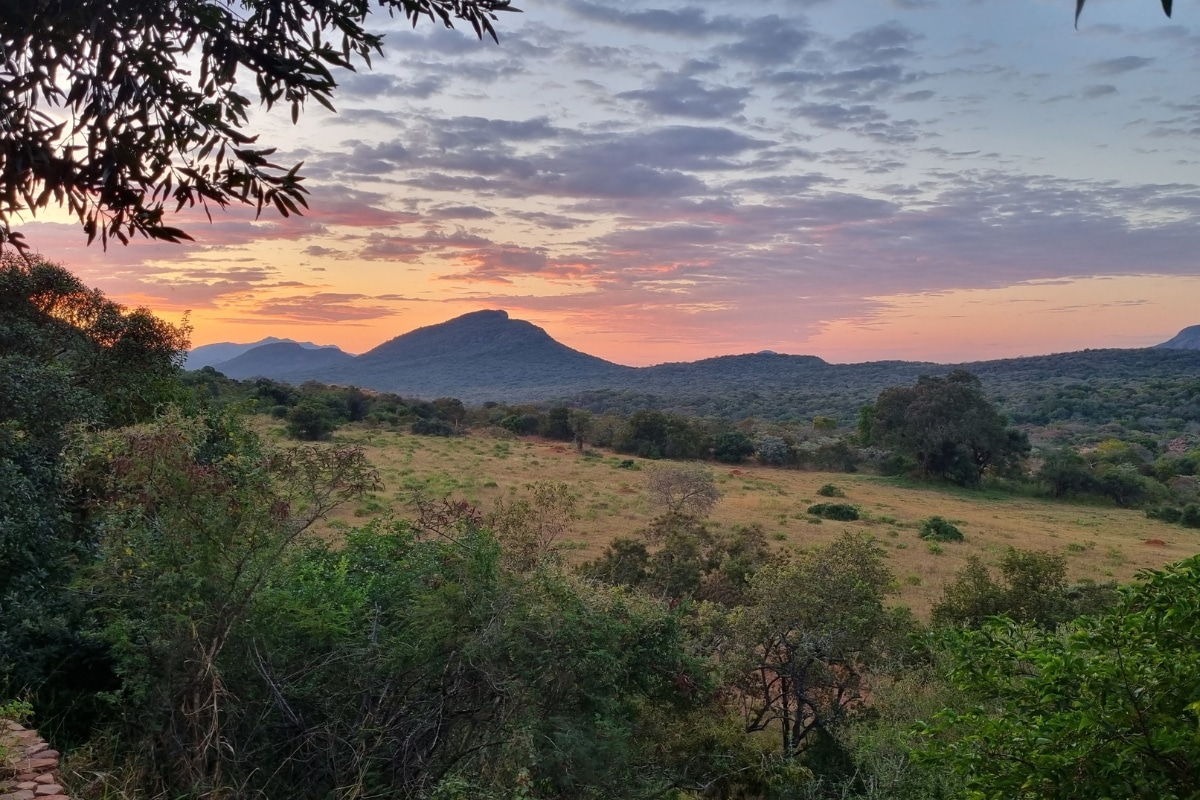
Rewilded landscape and wildlife corridor. Credit: Endangered Wildlife Trust.
Recent successes: expansion in the Soutpansberg Mountains and the rediscovery of the Golden Mole
We would like to celebrate two of their recent, great achievements:
Expansion of Protected Habitats in the Soutpansberg Mountains (Limpopo, South Africa)
The Endangered Wildlife Trust has recently acquired an additional 1,335 hectares of critical rainforest and mountain habitats, bringing its total conservation footprint in the region to approximately 2,800 hectares. This expansion connects vital corridors between the Medike Nature Reserve and Happy Rest Provincial Nature Reserve. It safeguards unique ecosystems—such as Northern Mistbelt Forest and endemic summit sourveld—while promoting climate resilience, preventing invasive species, supporting anti-poaching efforts, and stimulating sustainable livelihoods and eco-tourism in local communities.
Golden Mole Rediscovery
In a remarkable turn of events, the critically endangered De Winton’s Golden Mole, thought possibly extinct, was rediscovered in collaboration between Endangered Wildlife Trust and Re:wild in November 2023. This rediscovery made global headlines and serves as a powerful reminder that species believed lost may still be part of our living world. Nature often surprises us with her resilience to bounce back when given a helping hand.

Rediscovered Golden Mole. Credit: Endangered Wildlife Trust.
These are just examples of the breadth of the work of the Trust as they create space for nature and people to flourish together. Of course, this cannot come without investing in communities; they focus on expanding eco-tourism, sustainable livelihoods, and environmental education. Their work protects an array of wild species, but also safeguards the natural systems people rely on—clean air, water, food, and climate resilience.
From drylands to high-altitude wetlands; breathing life into 9 landscapes
Drylands (South Africa – Succulent & Nama Karoo, parts of the West Coast): in the arid succulent and Nama Karoo, they are protecting endangered species, from Riverine Rabbits and dwarf tortoises to rare succulents and birds of prey, working to build climate resilience and safeguard natural systems while supporting communities’ survival despite water scarcity.
Eastern Cape (South Africa): where semi-arid Karoo meets coastal grasslands, forests, and rugged mountain escarpments, they are reconnecting fragmented ecosystems through corridors, and protecting vital water sources. They are working with landowners, communities, and government to promote sustainable farming and help people adapt to climate impacts. Monitoring tools like Bioblitzes guide where protection is most needed.
Drakensberg (KwaZulu-Natal, Mpumalanga, Free State & Eastern Cape, South Africa): in these high-altitude grasslands, wetlands, forests and escarpments, they are protecting rare and endemic species, including Bearded Vultures, Wattled Cranes, Sungazer lizards. They work with landowners and communities to improve grazing practices, reduce invasive species, manage fire cycles sustainably, and secure water catchments that supply millions. They are also establishing a new nature reserve in the Northern Drakensberg.
Savanna (South Africa, Mozambique, Zimbabwe, Botswana): in the savanna, floodplains, and river systems such as the Limpopo and Olifants, they are protecting wide-ranging species like African Wild Dogs and Cheetahs, conserving vital water and grazing habitats, and engaging landowners and rural communities in landscape connectivity.
Kgalagadi (South Africa and Botswana): in this vast, arid region spanning over 59,000 km², they are protecting endangered species such as the African Wild Dog and Temminck’s Pangolin, and in doing so, collaborate with the Khomani San people to integrate traditional knowledge into conservation practices.

Looking out at rewilded wildlife corridor. Credit: Endangered Wildlife Trust.
Kavango Zambezi Transfrontier Conservation Area (Angola, Botswana, Namibia, Zambia, Zimbabwe): spanning over 201,000 km², KAZA is the world’s largest transfrontier conservation area, encompassing diverse ecosystems like floodplains, forests, and wetlands. It supports over 3,000 plant species and a vast array of wildlife, including the continent’s largest population of African Elephants, as well as African Wild Dogs, Lions, and Cheetahs. EWT collaborates with local communities to strengthen conservation-based livelihoods, develop long-term finance mechanisms and secure migratory routes amid increasing development pressures.
Zambezi Delta to Malawi (Mozambique & Malawi): this corridor links vital ecosystems and supports large-scale wildlife movements and rich wetlands. Local communities, who rely on these ecosystems for water, farming, and resilience in the face of climate change, are integral to their efforts.
Niassa–Selous Ecosystem Transfrontier Conservation Area (Mozambique & Tanzania): stretching across northern Mozambique and southern Tanzania, this vast area encompasses river systems, wetlands, and miombo woodlands, supporting species from Black Rhinos to Pel’s Fishing Owls. EWT collaborates with partners to reduce illegal trade and poaching, and develop sustainable finance mechanisms to make conservation part of the local economy.
East Africa Crane (Uganda, Kenya, Rwanda, Ethiopia): in the high altitude wetlands and grasslands, they are protecting Crane populations, raising awareness and data collection on the species’ presence while ensuring infrastructure development respects their nesting behaviours. They are collaborating with water and grazing management and developing finance models for local conservation leadership.
Future Fit Strategy: core values and ambitious goals
The Endangered Wildlife Trust Future Fit Strategy 2025-2050 is based on three programmatic actions:
- Stabilise at least 8 threatened species populations
- Restore and protect vast landscapes
- Empower people, by training 400 conservation leaders and co-developing 10 climate-smart, nature-based economies with Indigenous Peoples and Local Communities
Our Future Fit purpose is to drive the implementation of Nature-based Solutions, especially focused on habitat restoration towards climate adaptation and resilience, across critical ecosystems within the EWT’s priority landscapes. We are also driving the reduction and ultimate eradication of all critical threats facing species across critical landscapes, such as vultures and carnivores, in order to establish safe spaces for wildlife, and people, to thrive.
EWT’s CEO, Yolan Friedmann.
Following core values of Respect, Impact, Value all life, Relationships, and Ethical conduct (RIVER).
This sets rewilding as a pathway to shared resilience instead of a trade-off, a social contract, where people are empowered as stewards of the living systems they depend on. Get involved here.
The Global Rewilding Alliance is proud to have Endangered Wildlife Trust as a core partner in our global network.