Credits: YIARI
YIARI is a nonprofit organisation founded in 2008, operating across West Java and West Kalimantan (Borneo), Indonesia in collaboration with the Ministry of Forestry (MoF). With a team of nearly 300 people, YIARI has rescued, rehabilitated, and released over 100 Orangutans into protected forest since 2016, while also restoring 260 hectares of degraded peatland habitat. YIARI runs Indonesia’s first Slow Loris rehabilitation centre and holds globally accredited sanctuary status for both centres – the Slow Loris and Orangutan centres. Their holistic approach weaves together wildlife care, community empowerment, and public health to restore and protect some of Indonesia’s most threatened ecosystems.
Imagine a peatland forest where Orangutans once again move freely through the canopy, dispersing seeds and supporting the recovery of the forest around them — and where the community below is the reason they are back. As the wildlife returns, so too does the resilience of local communities, strengthened by better access to healthcare, improved livelihood opportunities, and greater empowerment.

An Orangutan released from their transport cage into the wild. Credit: YIARI
YIARI is bringing this possibility to life across West Java and West Kalimantan. What started as a primate rescue centre, mainly rehabilitating Orangutans, Macaques, and Slow Lorises has grown into a wider conservation organisation that also runs Indonesia’s first Slow Loris rehabilitation centre.
As pressure on the region’s unique wildlife and natural systems increased, the team realised that lasting impact would require looking beyond rescue alone and addressing the root causes behind the continuous influx of primates in need of care: habitat loss, human-wildlife conflict, illegal trade and limited livelihood options for local communities.
They now hold globally accredited sanctuary status and takes a holistic approach that weaves together wildlife care, community empowerment, and public health to restore and protect some of Indonesia’s most threatened ecosystems.

One of the Slow Lorises under the care of YIARI until they are ready to be released into the wild. Credit: YIARI
Addressing the root causes through holistic rewilding
Today, YIARI continues to manage a functioning rescue centre, but their activities have expanded into a broader rewilding vision supported by a multidisciplinary approach: habitat protection, supporting human-wildlife coexistence, education and community development in partnership with government agencies, universities, and other stakeholders.
Communities are at the centre of each project – a testament to the deep connection between human wellbeing and wildlife recovery.
From former hunters who have seen wildlife decline, to villagers who are now proud agents of species recovery, and the locally-based YIARI teams themselves, people play a central role as stewards of the land and its wildlife. This work builds on local knowledge, customary values and sustainable forest-use practices, helping to reduce hunting pressure on Orangutans, Gibbons, Hornbills and other vulnerable species while strengthening community-led conservation.

YIARI’s team walking through fields transporting Slow Loris crates for release. Credit: YIARI
To make this possible and help ensure these values are not lost, YIARI runs a Community Empowerment Programme centred around sustainable livelihoods, environmental education, and responsible natural resource management practices.
This means practical support: helping farming groups develop more resilient and sustainable agricultural practices, providing access to skills training, and working alongside communities to build economic models that do not depend on clearing or hunting.
It also means education, from preschool children learning about the wildlife on their doorstep, to adult community members trained as forest monitors and fire prevention teams.

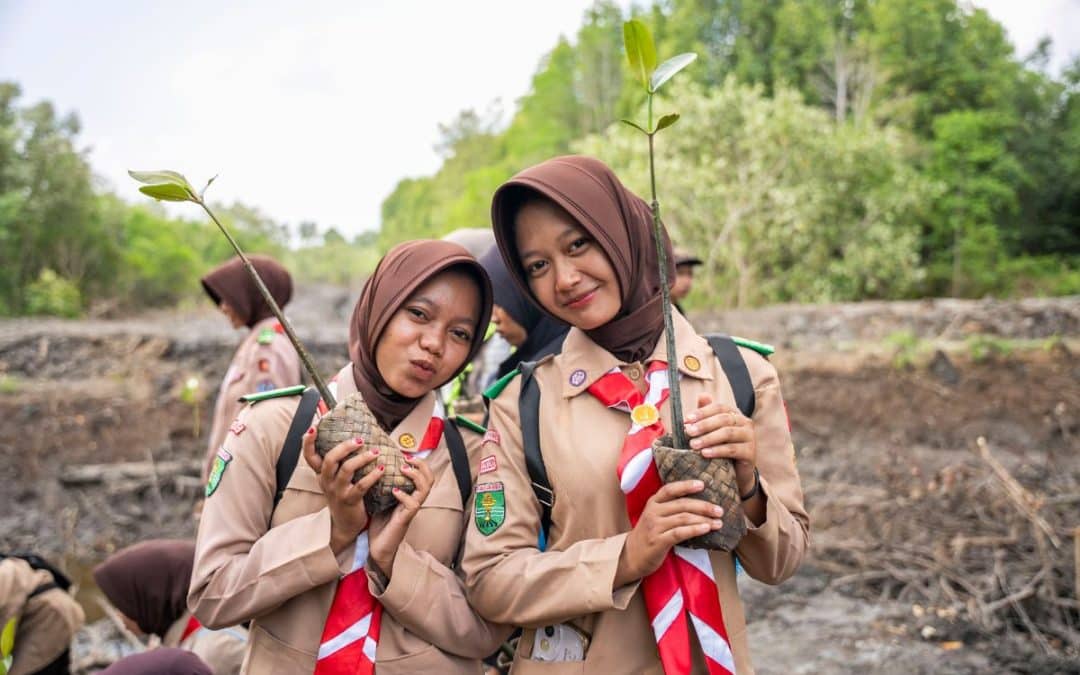
The “Power Mamas” also assist in mangrove rehabilitation and give talks to children on the importance of careful management of land that continues to change around them. Credit: YIARI
Community-led Wildfire Prevention
Forest fires are one of the main challenges. Year after year, peatlands, Orangutans’ habitat, are ravaged by never-ending wildfires. These fires are made more severe by mining and palm oil plantation expansion which reduces the land’s capacity to absorb and retain moisture. As a result, the Orangutan’s habitat is destroyed, forcing these key ecosystem engineers to leave the landscape, and disrupting the essential role they play in supporting forest regeneration. Furthermore, increasingly harsh dry seasons linked to climate change can turn carbon-rich peatland into fuel for fire.

A Power of Mama volunteer firefighter in West Kalimantan. Credit: YIARI
In 2022, YIARI established female-led forest fire prevention and firefighting teams across key areas in West Kalimantan. Collectively known as “The Power of Mama,” these teams are transforming attitudes towards the role of women in conservation, becoming role models and beacons of hope in their communities, while also helping to protect critical habitat.
The YIARI team, 300 people strong, is working across Sumatra, West Java and West Kalimantan regions to reverse the trend. They are already rewilding 260 hectares of degraded land to support the recovery of primate habitat.
After the initial rewilding stages, ongoing maintenance includes caring for the recovering forest cover and monitoring wildlife as it naturally returns to the landscape.

YIARI’s team walking through young trees. Credit: YIARI
One Health: the state of nature is the state of our own health
YIARI endorses the “One Health” principle, which recognises the connections between human, animal and environmental health. This integrated approach helps reduce risks linked to zoonotic diseases, including those that can spread to humans through close contact with wildlife. Restoring ecosystems is a fundamental part of this approach, supported by education and awareness activities on the relationship between zoonotic disease risk and wildlife consumption, rabies vaccination for animals, and animal market management.
Such a multidisciplinary approach is what rewilding is truly about. To achieve long-term landscape change, it is necessary to incorporate the human dimension into ecosystem recovery.


YIARI’s team in action on multiple front. Credit: YIARI
Reintroductions: bringing Orangutans back home
Building on the foundations of protected and continually restored habitats, the possibility of reintroducing rehabilitated Orangutans becomes reality. Since 2016, YIARI has released 85 Orangutans into protected conservation areas — a landmark achievement in Indonesian wildlife recovery. To do this, YIARI follows IUCN guidelines to identify suitable habitats without existing Orangutans populations, helping to ensure that newly released individuals do not affect resident groups.
Post-release, dedicated monitoring teams, including members of surrounding village communities, track each animal for one to two years following their return to the wild, to ensure they are adapting well and thriving in their new forest home.

A rewilded Orangutan hanging from a tree. Since 2016, YIARI has released 85 Orangutans into protected conservation areas — a landmark achievement in Indonesian wildlife recovery. Credit: YIARI
YIARI’s success begins where the widespread tendency to treat wildlife and people as separate comes to an end.
By aligning the interests of people and natural systems, both can begin to thrive together. YIARI has turned former hunters into forest guardians, rehabilitated and released Orangutans back into protected forest, and built the local resilience needed to sustain these gains for the long term. Its model of rewilding works within a context of human development, reigniting the ancient partnership between people, wildlife and nature.
We are proud to have YIARI within the Alliance as a strong example of what the intersection between wildlife, human wellbeing, and healthy ecosystems can achieve.


