

Credit: Habib Ali Hamit / Sahara Conservation
The Scimitar-Horned Oryx, extinct in the wild since the late 1980s, began its historic return to Chad’s Sahel in March 2016. This success story, spearheaded by Sahara Conservation, the Government of Chad, and the Environment Agency of Abu Dhabi (EAD), saw the species downlisted from ‘Extinct in the Wild’ to ‘Endangered’ in 2023, with over 600 Oryx now roaming freely.
The Oryx are vital ecological engineers, increasing seed germination and helping reverse desertification. Future success is rooted in a shared governance model that integrates biodiversity protection with the sustainable development of local pastoralist communities, making the Oryx a symbol of national pride and environmental health.
On 14 March 2016, exactly a decade ago today, the Scimitar-horned Oryx began its return from extinction in the wild with a major reintroduction. This majestic species was revived thanks to the determined efforts of our Alliance Partner, Sahara Conservation.
Speaking to our team members, their Founding member, former CEO and Senior Advisor, John Newby, noted that the reintroductions were relatively straightforward because “all it took was strong cooperation, a lot of money, a source of suitable animals, and international technical know-how. The next chapter and real story lie in how we sustain the reintroductions into the future.”
While the return of a species from the brink of extinction is hailed as a miracle, the true narrative is far more grounded and complex. Together, we will delve into the untold story of what happens after the crates are opened and the cameras turn away, when the end of extinction for a species marks the beginning of coexistence with people.
The Last Wild Herds
To understand the magnitude of this achievement, we look back through the eyes of those who witnessed the silence fall over the desert. John Newby arrived in Chad in 1971, a young biologist witnessing a landscape teeming with life despite the harsh conditions. During the 1974 wet season, he recalls the awe of seeing massive herds of Oryx gathered on fresh green pastures. They ranged across the sub-desert grasslands from the Atlantic coast of Mauritania to Sudan and the Nile Valley, collectively known as the Sahel.
Genetic studies indicate that during the humid early Holocene (roughly 11,700 years ago), these vast grasslands supported a contiguous population of at least one million Oryx, revealing the species’ pivotal role in shaping the Sahelian ecosystem for millennia before its rapid decline in the recent past. As a stark example of shifting baselines, the herds Newby witnessed in thousands were the vibrant, living legacy of that history.
Yet, this period of abundance was nearing its end. The region faced the double edge of severe droughts and rising civil unrest in the late 1970s. Squeezed between warring factions, the Oryx stood no chance against modern weaponry. By the late 1980s, the Scimitar-horned Oryx had vanished from the wild, existing only in captivity.
The magnificent antelope, with its sweeping horns and stark white coat, had become a ghost in its own home. However, a remnant of the Chadian population survived in zoos and private collections globally, waiting for a chance to return.
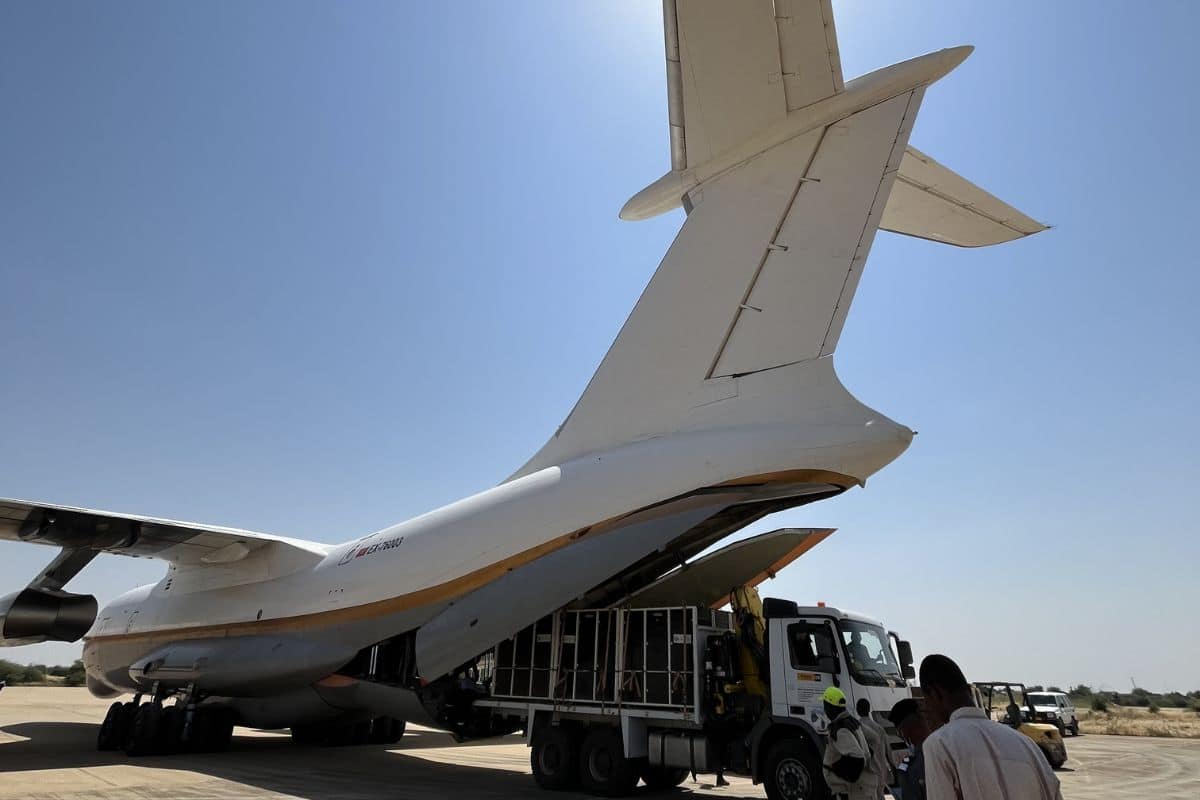
Unloading crates carrying the Oryx from a Cargo Plane. Credit: Sahara Conservation
Coalition of the Willing
The road to recovery required a partnership of extraordinary scale and determination. John says that this groundbreaking project owes its continued success to the critical leadership roles played by the Government of Chad, specifically the Ministry of Environment, Fisheries and Sustainable Development, and the Environment Agency of Abu Dhabi (EAD), UAE.
While Sahara Conservation provided the coordination and on-the-ground management, the Chadian government offered the sanctuary of the Ouadi Rimé-Ouadi Achim Faunal Reserve, ensuring the legal framework and local acceptance necessary for such an ambitious endeavour. Simultaneously, the EAD served as the engine of the operation, from curating a genetically diverse “world herd” in the United Arab Emirates to underwriting the logistical costs of flying the animals back to Africa.
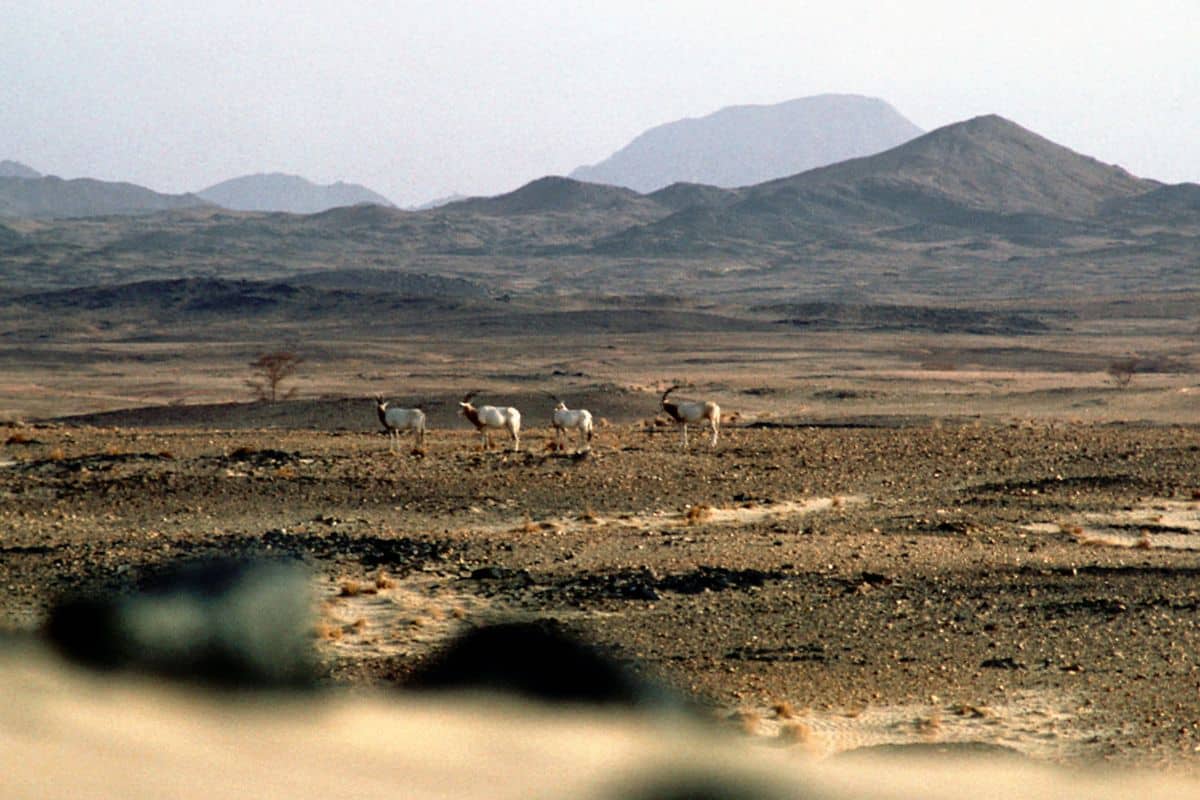
Last Oryx in Niger. Credit: Sahara Conservation
The Great Homecoming
In March 2016, what was deemed impossible became a reality. A chartered cargo plane touched down at Abéché airport in eastern Chad, carrying 25 Scimitar-horned Oryx from Abu Dhabi. The crates were unloaded, and the animals took their first steps onto Chadian soil in over thirty years.
What followed astonished everyone. Despite generations born in captivity, the returned animals showed an innate ability to reclaim their ancestral knowledge. Soon, the wild-born calves became one again with the Sahelian ecosystem, intuitively identifying local plants and finding moisture in bitter wild melons during the dry season. Today, over 600 Scimitar-horned Oryx roam freely in the wild. The success of this initiative was recognised globally in 2023 when the species was officially downlisted from ‘Extinct in the Wild’ to ‘Endangered’ on the IUCN Red List of Threatened Species.
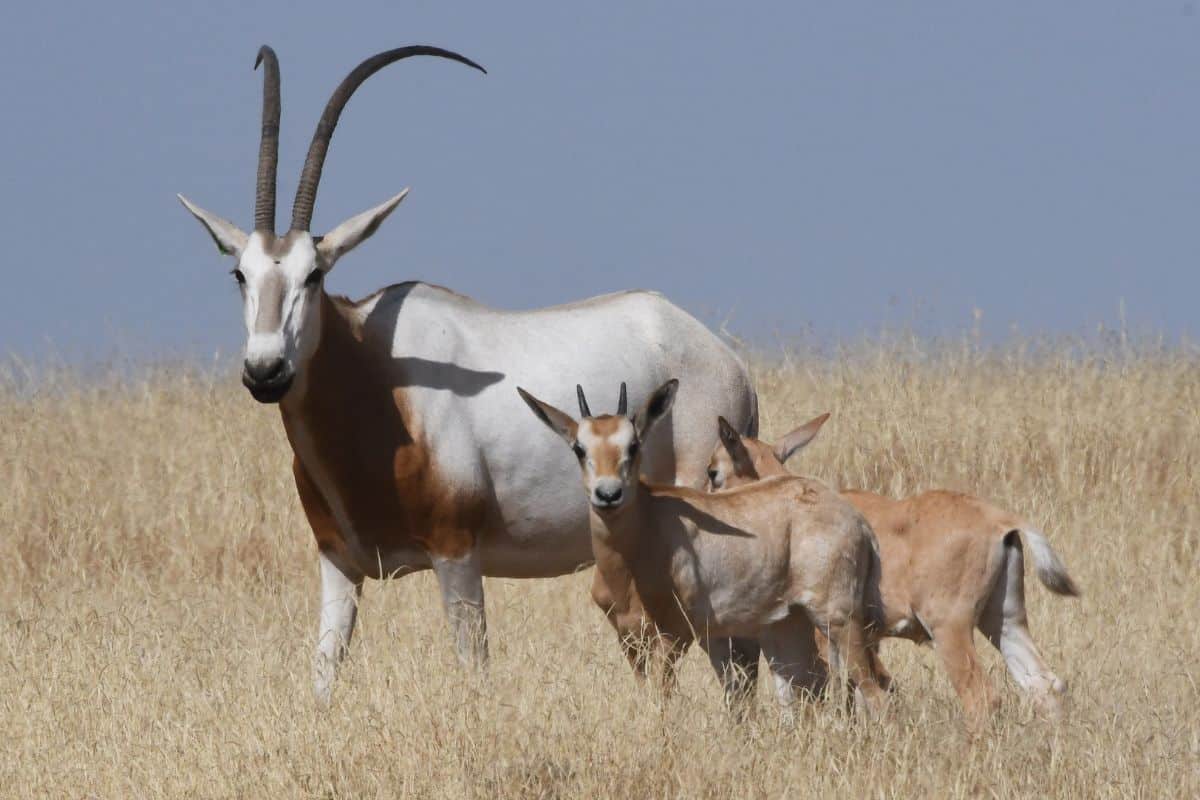
Oryx Calves with Adult (October 2025). Credit: John Newby, Sahara Conservation
This biological triumph is mirrored by a growing cultural pride. The Oryx has become a cause célèbre in Chad – right from the original release, which was met with riotous applause from crowds gathered at the airport, and was celebrated by local dignitaries who personally assisted in lifting the crate doors.
For the pastoralists inhabiting these vast Sahelian grasslands, the animals are revered as an indicator of environmental health, a belief powerfully reinforced when the season’s first rains auspiciously fell around the Oryx pens upon their return. The antelopes even appear on the new series of Central African CFA franc notes released into circulation in 2022 and used across six countries, which Sahara Conservation’s current CEO Tim Woodfine delightedly pointed out. This symbolic and physical integration suggests that the species is reclaiming its place in the national identity as much as in the ecosystem.
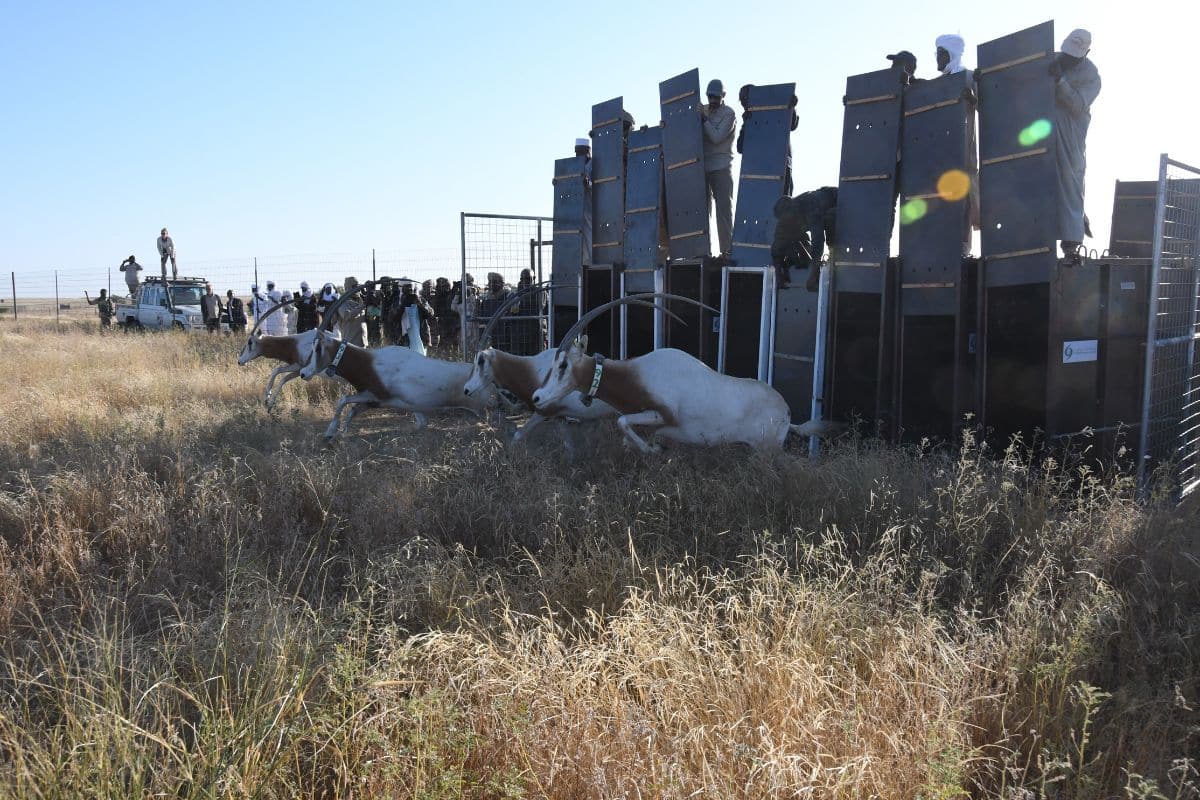
Oryx Release (November 2024), Credit: John Newby, Sahara Conservation
Ecological Importance of the Oryx
Upon their return to the vast Sahelian grasslands, the Oryx resumed their vital role as ecosystem engineers. As they traverse hundreds of kilometres, they consume various types of vines, herbs, fruits, grasses, and seed pods. After digesting this organic matter, they deposit it elsewhere in a nutrient-rich dung, a process that significantly increases germination rates. For example, a key study on the closely related Arabian Oryx indicated that ingested and excreted acacia seeds were 250 times more likely to germinate!
Furthermore, their physiology is a marvel of resilience, possessing the extraordinary ability to survive months without water by consuming succulent plants; and can tolerate internal body temperatures up to 47°C (116°F) through adaptive hyperthermia, a trait they probably share with the other Oryxes: Arabian, Southern (Gemsbok) in Kalahari, and probably the Beisa (East African) Oryx in the Horn of Africa (Somalia, Tanzania, Kenya, Uganda and South Sudan).
Our Director Science-Policy-Practice, Magnus Sylvén says that this “explains why the return of large herbivores, like the Scimitar-horned Oryx and the Arabian Oryx, is crucially important for halting and reversing desertification. This would assist the work under the UN Convention to Combat Desertification (UNCCD), a global institution initiated at the UN Conference on Environment and Development (UNCED) in Rio 1992, which we, the Global Rewilding Alliance, now seek observer status with as part of our Rangelands initiative.”
The return of large herbivores, like the Scimitar-horned Oryx and the Arabian Oryx, is crucially important for halting and reversing desertification.
Magnus Sylvén, Global Rewilding Alliance’s Director of Science-Policy-Practice
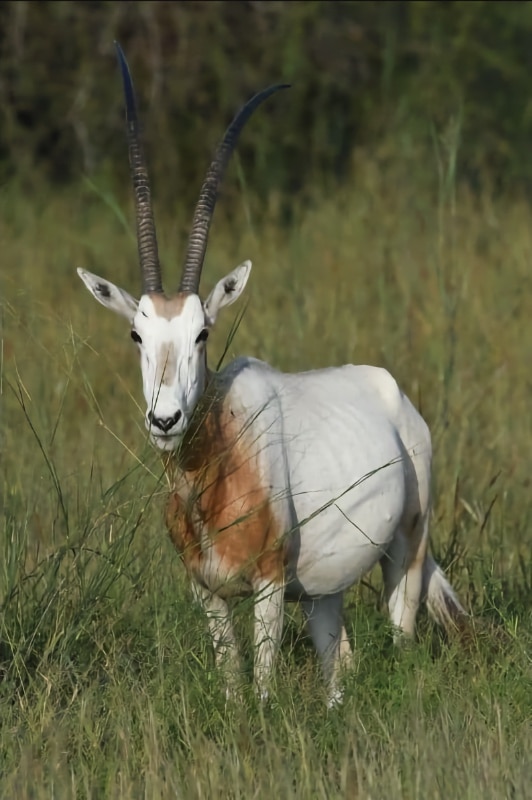
Scimitar-horned Oryx. Credit: Sahara Conservation
Addressing the Bedrock of the Issue
The Ouadi Rimé-Ouadi Achim Faunal Reserve, spanning a vast area of 77,950 sq km, is a place where pastoralists and their livestock have roamed for centuries. However, the present-day Sahel is different from the one the Oryx left decades ago and returned to. Land use has intensified, and the climate shifted. The sustenance of the Oryx depends on the acceptance and support of the local communities. It requires moving from “passive support,” where locals simply tolerate the wildlife, to “active support,” where they see the Oryx as an integral part of their own prosperity.
Violeta Barrios, Chief Operating Officer of Sahara Conservation, spoke to us about how they embraced this reality by fostering a model of shared governance. Their 2025 management agreement with the Chadian government sets in motion a participatory approach, simultaneously addressing biodiversity protection and the sustainable development of local populations. This involves mitigating competition for grazing and water by creating a mosaic of mutually agreed spaces where wildlife and livestock can access the resources they need. Despite looming threats from bushfires, they continue to navigate these challenges with the local communities.
Governance and Community Voice
To operationalise a shared existence, Sahara Conservation deploys an innovative zoning strategy that respects both ecological imperatives and human necessities.
Rather than imposing a blanket exclusion, the reserve is organised into a mosaic of use cases, which we previously touched upon. Zones of “controlled use” have been specifically delineated along critical seasonal riverbeds like the Ouadi Kharma and Ouadi Achim. These areas acknowledge the vital need for livestock to access water and forage while simultaneously protecting the vegetative barriers that halt desertification. In parallel, strict conservation zones provide safe havens for the Oryx and many other species to breed, ensuring that the wildlife can replenish itself without the immediate pressure of human encroachment. This spatial organisation transforms the reserve into a landscape of mutual benefit.
Coexistence is further reinforced by a governance model that elevates local voices. The establishment of the Conseil Consultatif Interprovincial de Gouvernance (CCPG) integrates local authorities, administrative officials, and representatives from women’s and youth associations directly into the decision-making process.
This forum ensures that the management of the reserve is responsive to the realities of the people living within it. Additionally, the presence of technical teams provides a collateral benefit to pastoralists through veterinary vigilance; monitoring for diseases like anthrax or foot-and-mouth disease protects both the wild herds and the domestic livestock that are the lifeblood of the local economy.
Moreover, the revitalisation of the landscape also creates opportunities for responsible ecotourism, which is envisioned to generate revenue that can be reinvested into community development.
A Blueprint for the Future
The journey of the Scimitar-horned Oryx offers a beacon of hope and a tangible blueprint for the restoration of the Earth’s great rangelands. It demonstrates that with sufficient cooperation, resources, and technical expertise, we can halt and reverse the damage of the past. Yet, it also serves as a reminder that true ecological recovery is a long-term phenomenon.
The next phase of this story belongs to the rangelands themselves, along with all the beautiful species that call it home. Through the Global Rewilding Alliance’s Rangelands Working Group, we advocate for an “Ecological Uplift” that integrates wildlife recovery with functional landscapes.
The success in Chad proves that vibrant wildlife populations and thriving pastoral communities can share the horizon.
As we look ahead to the United Nations’ International Year of Rangelands and Pastoralists (IYRP) in 2026, the goal is to ensure that the return of the Oryx lays the foundation for a resilient, wilder future where all beings of the natural world flourish together.
Find out more about Sahara Conservation’s inspiring work on their website.
References:
Newby J. The fall and rise of the Scimitar-horned Oryx: A Personal Account – Part I: The Fall.
Newby J. The fall and rise of the Scimitar-horned Oryx: A Personal Account – Part II: The Rise.
Sahara Conservation. A historic agreement for the management of the Ouadi Rimé–Ouadi Achim Faunal Reserve in Chad. Published July 11, 2025.
Sahara Conservation. Ouadi Rimé – Ouadi Achim Faunal Reserve. Published July 29, 2025.
Sahara Conservation. Scimitar-horned oryx reintroduction. Published July 30, 2025.
Polak T, Gutterman Y, Hoffman I, Saltz D. Redundancy in seed dispersal by three sympatric ungulates: a reintroduction perspective. Animal Conservation. Published April 10, 2014.
Smithsonian’s National Zoo and Conservation Biology Institute. Scimitar-horned oryx.
Ministère de l’Environnement, de la Pêche et du Développement Durable, Worgue YL, Yamtibaye T, Direction de la Faune et des Aires Protégées du Ministère de l’Environnement, de la Pêche et du Développement Durable de la République du Tchad, Sahara Conservation. PLAN D’AMÉNAGEMENT ET DE GESTION 2023 – 2032.
Walker M, Johnsen S, Rasmussen SO, et al. Formal definition and dating of the GSSP (Global Stratotype Section and Point) for the base of the Holocene using the Greenland NGRIP ice core, and selected auxiliary records. Journal of Quaternary Science. Published October 3, 2008.
Woodfine T, Gilbert T. The Fall and Rise of the Scimitar‐Horned Oryx. In: Antelope Conservation: From Diagnosis to Action. Published June 24, 2016.
Iyengar A, Gilbert T, Woodfine T, et al. Remnants of ancient genetic diversity preserved within captive groups of scimitar‐horned oryx (Oryx dammah). Molecular Ecology. Published May 15, 2007.