
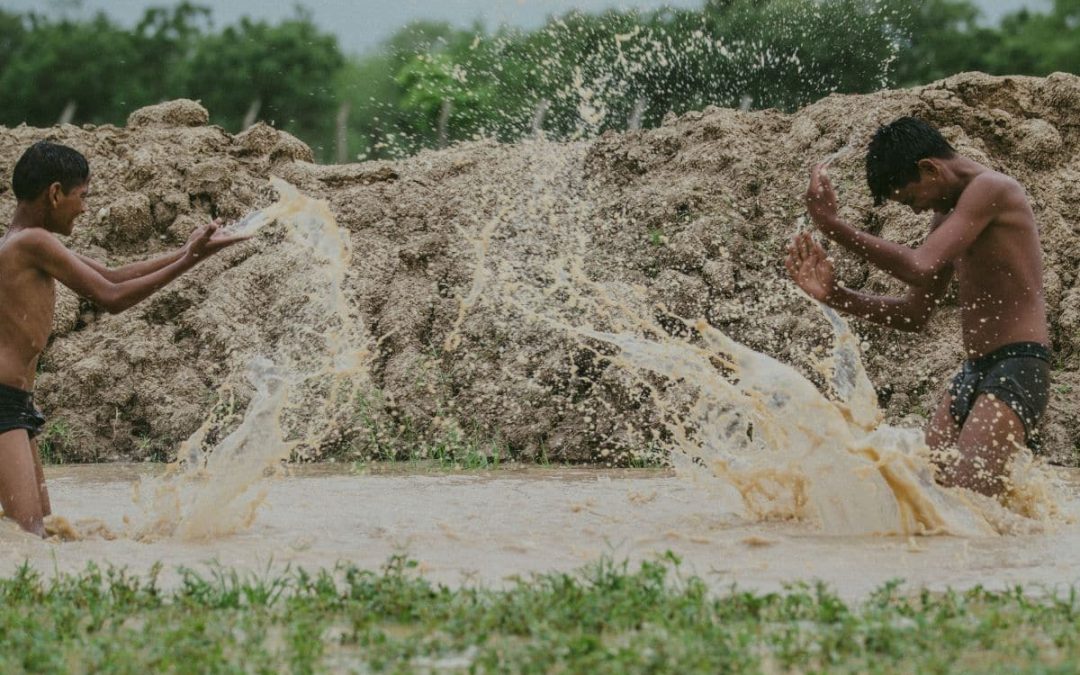
Monsoon at Dhun (July 2023). Credits: Dhun
Dhun is a pioneering, regenerative neighbourhood in arid Jaipur, India. It transformed 500 barren acres into a biodiverse, water-positive habitat (restoring water, planting 300,000+ trees), and is India’s first real estate B-Corp. It dedicates over 70% of its land as green zones, focuses on community welfare, and is a globally recognized, replicable model for drylands worldwide.
The Global Rewilding Alliance proudly welcomes Dhun Life or Dhun, a pioneering mixed-use neighbourhood prototype that redefines real estate through regeneration. The project seeks to create a blueprint for the future of living—one that is inclusive, regenerative, and grounded in environmental, social, and physical well-being—by harmoniously blending traditional wisdom with modern technology.
Developed on 500 acres of once-barren land, Dhun restores water, food, and biodiversity ecosystems while optimising living, working, learning, and recreation holistically. Conceptualised for a limited population of 8,500 people, it is located in peri-urban Jaipur, the capital of the hot and arid desert state of Rajasthan in India. The prototype has already transformed the land into a thriving human and nature co-existing habitat through generational thinking and the principles of new urbanism. Remarkably, Dhun is certified as India’s first real estate Benefit Corporation (B-Corp) for the lasting positive impact it has so far created and continues to create.

New lake in Dhun (June 2023). Credits: Dhun Jaipur
Rewilding the Barren Landscape
As of 2013, this 500 acres landscape held only 30 trees and suffered acute water scarcity. Today, through a profound synthesis of traditional Rajasthani water wisdom, innovative nature-based design and modern technology, it stands as a beacon of ecological regeneration. A meticulously engineered network of bioswales, ponds, and lakes captures over 550 million litres of rainwater annually. This hydrological resurrection enabled the planting of over 300,000 trees, which in turn support nearly 180 bird species and regenerative food systems yielding 60+ varieties of organic produce.
Watch their 3-minute impact video
Furthermore, Dhun is being developed with natural capital accounting and water resilience at its core. The prototype is designed for a limited population footprint, enabling the team to build on less than 30% of the land, while safeguarding more than 70% as green, no-build zones. It is while they continue to explore ways to reduce the carbon footprint of Dhun’s built environment by experimenting with sustainable, locally sourced materials, including mud, stone, and reclaimed heritage structures.

Material Research and Prototyping by KADK (Dec 2023). Credit: Dhun
Nature and Community as Co-Creators
By letting water flow and allowing soil to revive with added organic matter and nitrogen-fixing grasses, the prototype has enabled native biodiversity to reclaim its place. Dhun’s “ecology-first” ethos ensures ecosystems function holistically in its semi-arid context while supporting thriving biodiversity and microhabitats. Planted forests of Khejri, Desi Babool, Jamun, Ber, Khair, and other native trees and restored grasslands host resident and migratory birds like the vulnerable Common Pochard and Southern Grey Shrike, and the near-threatened White-eyed Pochard. Thousands of invertebrates, mammals, and reptiles have also made this land their home, including the vulnerable Indian Flapshell Turtle.
Dhun beautifully embodies the principle of inclusive prosperity with community as stewards. For instance, The I Love Foundation (a sister-concern non-profit of Dhun) and Deshpande Foundation built 59 farm ponds for underprivileged farmers from around Dhun in the project’s pilot phase (2023-24), with an aim to build 1,000 such ponds. These ponds have increased agricultural yield (doubling income!), enabled fish farming, and replenished the water table. This synergy demonstrates that the most sustainable form of ecological regeneration is one that is culturally rooted and community-led, where people see themselves as active, benefitting custodians of the land they call home.
Bringing Communities Together
Dhun aspires to be a diverse community of creators, entrepreneurs, professionals, and purpose-driven people while forming symbiotic relations with local communities. Immersive interactions and collaborative actions underpin Dhun’s regenerative socio-cultural environment. Such exchanges are fostered through its School of Pursuits & Passions, pilot testing them in the form of residencies, well-being retreats, farmers’ markets, dialogues, workshops, nature trails, etc.

Building Regenerative Communities. Credit Dhun
Similarly, Dhun School enables inquisitive learners from both nearby villages and urban Jaipur to work with experts on projects that solve real-world problems. The Dhun team is also training local youth on the aspects of filmmaking and hospitality, and encouraging farmers to grow native food species that are safe, efficient, and nutritious. Besides generating jobs, these interventions aim at enabling local communities to form micro-enterprises and cooperatives as Dhun creates awareness, builds capacities, and serves as a marketplace for them.

Glimpse of Dhun School, Learning with Nature. Credit Dhun
Global Recognition, Grounded Impact
Founder and CEO of Dhun, Manvendra Singh Shekhawat, is a visionary explorer and systems thinker working at the intersection of experiential tourism, culture conservation, ecological restoration, and social entrepreneurship. Under his leadership, Dhun has emerged as one of four global urban development pilot projects—and the only one from India—supported by a partnership between Earthna, The Qatar Foundation, and The King’s Foundation. The project has also been featured by the Earthna Summit, the UNGA 100 Disruptors Summit, UNCCD COP16, Earth One’s Atlantic Crossing, and Urban Land Institute (ULI) Asia Pacific Summit.

Manvendra Singh Shekhawat, Founder, Dhun at the UN – WeThe Planet session (September 2024). Credit: Dhun
As an evolving microcosm of regenerative urbanism, Dhun presents a radical reimagining of human settlement and provides a replicable template for drylands worldwide—home to 2 billion people across 40% of Earth—by proving that an evidence-based, contextual synthesis of indigenous wisdom and modern technology can transform drylands into biodiverse, water-positive, climate resilient, and community-centric habitats. Dhun embodies rewilding’s essence: freeing land to regenerate on its own terms while humans co-create within its rhythms.
Learn more at dhun.life.