
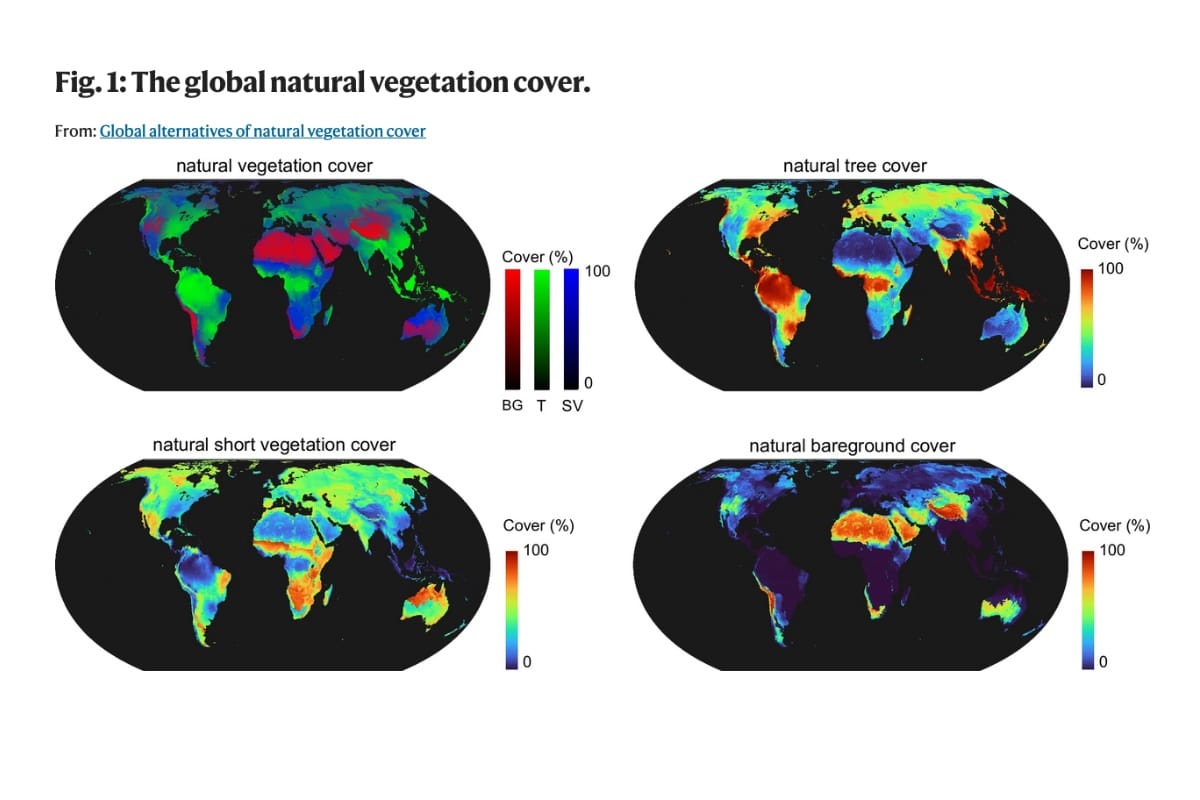
Preserving and restoring terrestrial ecosystems is essential to preventing the decline of life on Earth. To guide global conservation efforts, this paper presents a detailed counterfactual map showing Earth’s natural tree, short vegetation, and bare ground cover. This map accounts for environmental filtering along with realistic scenarios of fire frequency and wildlife herbivory. The most likely scenario suggests 43% (5669 ± 74 Mha) of land could support trees, 39% (5183 ± 86 Mha) shrubs and grasses, and 18% (2352 ± 59 Mha) bare ground. Adjustments in fire and herbivory could shift a minimum of 675 Mha of land, stressing the importance of considering alternative outcomes when restoring a landscape. The findings also suggest that adjustments in fire frequency and wildlife herbivory could have a greater impact on natural vegetation than expected climate changes by 2050, highlighting decision-makers’ responsibility to guide restoration toward a sustainable and biodiverse future.

Policy & Community Wins for Nature: $200M for 100 species, a New UNESCO Site & More
2026 is delivering major wins for nature recovery and rewilding. Credit from left to right: 1. Filmico, Acandi Wildlife Sanctuary 2. Marcus Westburg, Rainforest Trust 3. Zanji Sikhala, IFAW 4. Tsvibrav from Getty Images 5. Kamchatka 6. John Carnemolla from Getty...